AMD vs Intel Platform Loyalty and Upgrade Path Lock-In
AMD's AM5 socket outlasts Intel's platforms, saving upgrade costs down the road.
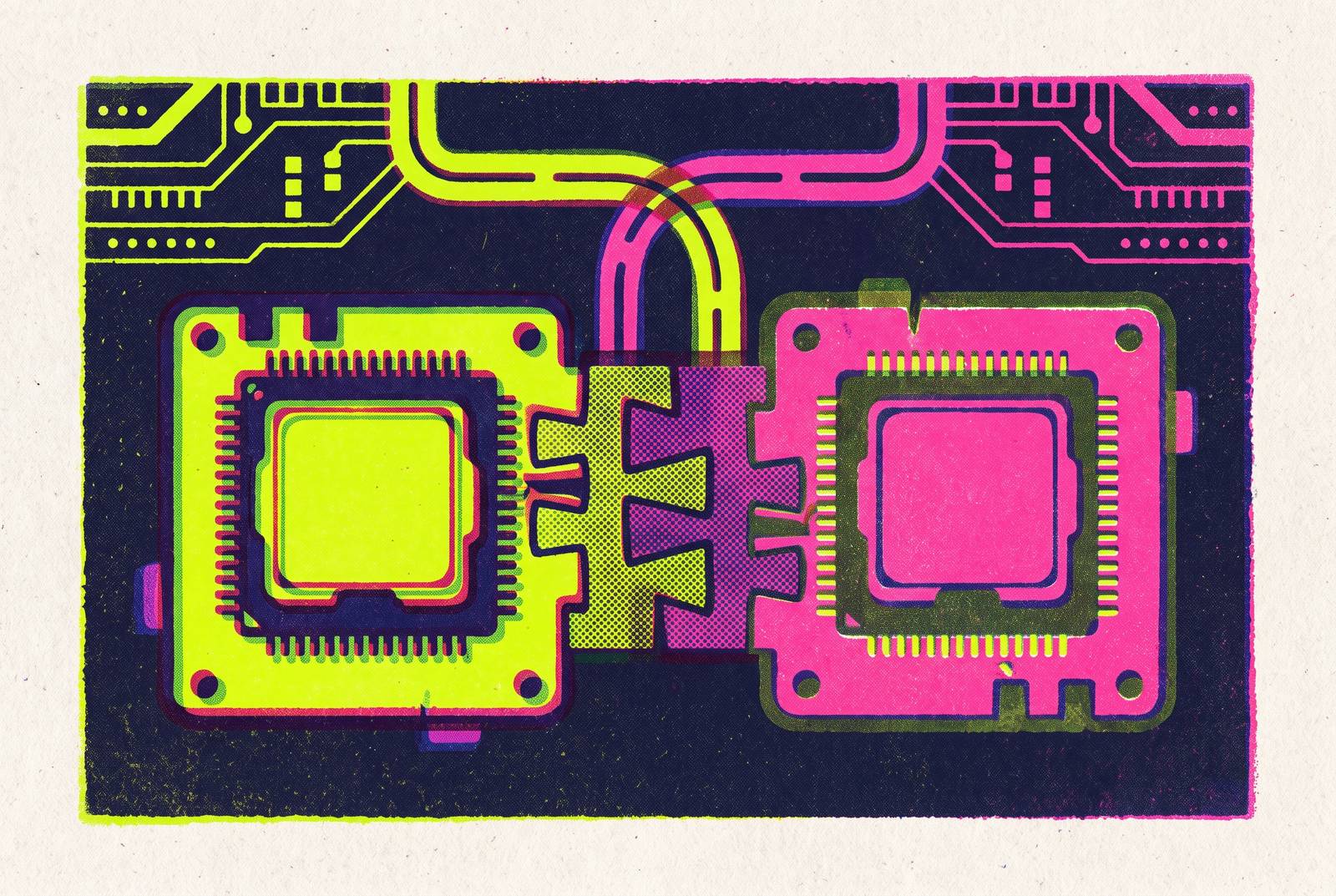
Picture a builder three years from now, ready to swap in a faster chip, discovering that the upgrade also requires a new motherboard, new cooling mounts, and a fresh look at memory pricing. That scenario is the real subject of any AMD vs. Intel comparison in 2026, more than any single benchmark chart. Most builders treat the CPU as the purchase that matters and the board underneath it as an afterthought, but the socket and board are what decide whether the next upgrade costs a fraction more or more than double. A CPU typically lives inside a given socket for three to five years, while the motherboard that houses it stays in the case for the CPU's entire run and often beyond. Both Intel's Nova Lake-S and AMD's Zen 6 have slipped into 2027, so the boards being bought right now will sit in service longer than most builders originally planned, which raises the stakes on choosing the right socket now.
How socket lock-in creates a hidden second purchase
The term for this is the platform tax, and it works in one of two ways depending on whether the socket is still alive when the upgrade urge hits. If the socket is still supported, a new CPU is a clean, single transaction: pull the old chip, seat the new one, flash the BIOS, done. If the socket has been retired, that same upgrade drags a new motherboard along with it. Both of today's major platforms are DDR5-only, so the memory kit itself usually survives a socket change, but the board still has to be bought new, and the whole memory stack often needs re-validation against a different chipset and a different memory controller. DDR5 prices are at generational highs in 2026, so any forced platform swap lands harder on the wallet than it would have a year or two ago. This isn't a theoretical risk invented for the sake of argument: Intel's LGA1851 is expected to carry Arrow Lake and one Refresh generation before LGA1954 replaces it for Nova Lake, so a builder who bought a Z890 board in early 2026 is looking at exactly this fork in the road within a generation or two.
AMD's AM5 commitment and what it guarantees
AMD has stated publicly that AM5 will carry support through 2029. A board purchased today is expected to remain compatible with Zen 6 desktop CPUs without forcing a motherboard swap. The AM5 socket itself is a 1,718-contact land grid array design shared across every Zen 4 and Zen 5 desktop chip, spanning the Ryzen 7000, Ryzen 8000G, and Ryzen 9000 lines. That kind of pledge is only as good as the company's track record of keeping it, and AMD has one clear data point in its favor: AM4, launched in 2016, ended up supporting five generations of Ryzen desktop processors across nearly a decade. That history doesn't guarantee AMD repeats the feat with AM5, but it gives the 2029 date more weight than a marketing promise usually carries. The AM5 chipset lineup also lets builders enter at different price points without losing that upgrade runway: X870E for enthusiasts, X870 for mainstream performance, B850 for mid-range gaming, and B650 for entry-level builds, all of them supporting PBO tuning regardless of tier. On the memory side, AM5's controller hits its efficiency sweet spot at DDR5-6000, which lines up with an infinity fabric frequency of 3000 MHz running in synchronous 1:1 mode. That gives a builder planning an AM5 system a validated memory target to aim for, rather than a reason to chase ever-higher kit speeds for marginal gains.
Intel's socket history and LGA1851's position for current buyers
Intel's recent socket history runs LGA1200, then LGA1700, then LGA1851, and now LGA1954 on the horizon. Each transition has asked buyers to replace the board along with the CPU when they moved to the next generation. LGA1851 arrived with the Core Ultra 200S series, known as Arrow Lake, and it follows that same pattern of pairing a new socket with a new CPU family, which narrows the in-platform upgrade room compared to AMD's multi-generation approach with AM5. The restriction goes beyond socket lifespan, too: LGA1851 limits CPU multiplier overclocking to Z890-series boards only, so a budget builder who picked a B860 board has no access to the tuning headroom that any AM5 chipset tier offers by default. Intel's platform has genuine strengths. The memory sweet spot on LGA1851 reaches DDR5-6400 via XMP 3.0 on both Z890 and B860 boards, and the memory controller is less sensitive to divider boundaries than AM5's, which is a real advantage for anyone who wants to push memory speed. That advantage only pays off, though, if the builder stays on LGA1851 long enough to use it. Arrow Lake also ships with a dedicated NPU rated around 48 TOPS, so builders doing on-device AI inference, background transcription, or AI-assisted noise cancellation through Windows get a meaningful feature. None of this changes the structural fact that LGA1851 buyers are working with a shorter runway than AM5 offers; it just means the runway comes with a few extra lanes.
Intel's LGA1954 signals and the current math
The strongest case against favoring AM5 right now rests on what Intel is reportedly planning for LGA1954. Intel appears to be designing the socket to support multiple processor generations, potentially Nova Lake, its successor Razor Lake, and further chips such as Hammer Lake, which would mark a real departure from LGA1851's short two-generation run. Intel's VP and General Manager of the Enthusiast Channel has said publicly that enthusiast feedback on platform longevity factors into Intel's roadmap decisions, and that future sockets could support more CPU generations than recent ones have. Part of the reported mechanism behind that claim is an expanded 64MB SPI ROM on Z-series LGA1954 boards, which would give the firmware more room to support multiple chip generations on the same board. A socket that can physically accept a future chip is not the same thing as a company committing, in writing, to ship the firmware that makes that chip run well. Intel has not published a dated, multi-generation commitment for LGA1954 the way AMD has for AM5 through 2029. For someone deciding today, Intel's signal reads as a stated intention rather than a pledge, while AMD's AM5 commitment is dated, public, and backed by a decade of AM4 precedent. Should Intel follow through on LGA1954 longevity, the platform tax argument loses much of its force for builders patient enough to wait for that generation. For anyone buying now, the asymmetry between a dated commitment and a stated intention still stands.
What the platform tax costs at each build tier
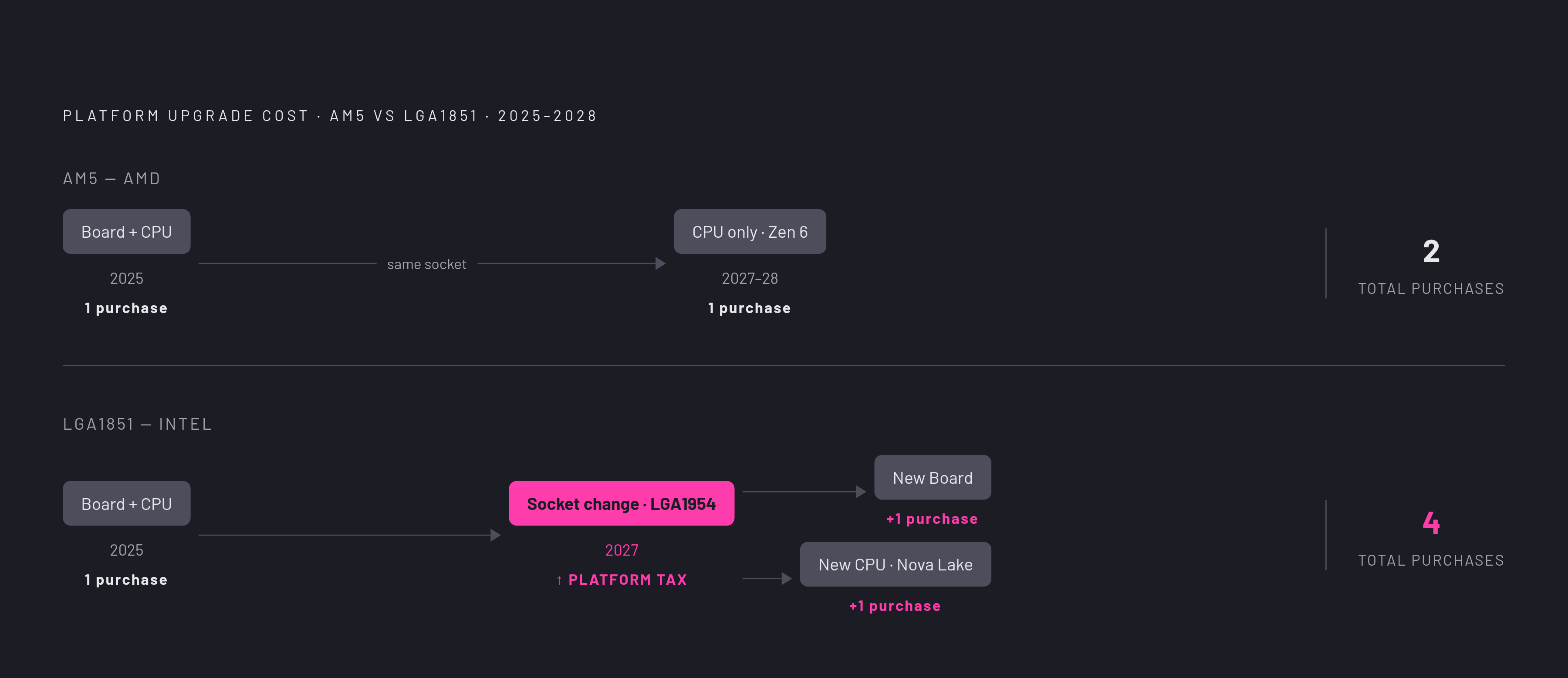
The platform tax doesn't land the same way at every price point, so here is what it costs at budget, mid-range, and enthusiast tiers. At the budget tier, AM5 makes a strong case for itself. The Ryzen 5 7600 is one of the better budget gaming chips on AM5, with the cheaper Ryzen 5 7500F offering an even lower entry price, and both sit on a platform with a confirmed upgrade path through 2029. A B650 board starts at an accessible price, and because the socket stays current, the next CPU swap won't require replacing the board. Intel's LGA1700 remains the cheapest way into a desktop platform in 2026, with the flexibility of running either DDR4 or DDR5, but it's an end-of-life ecosystem. A budget builder entering through LGA1700 has no further in-socket upgrade path waiting for them.
The mid-range tier is where the AM5 upgrade path pays off most clearly. The Ryzen 7 9700X, an 8-core chip at 65W with a $359 MSRP, sits on AM5 with a direct path to a future 3D V-Cache chip without any board change. A mid-range builder on AM5 can add an X3D chip in two years as a single purchase, while the equivalent builder on LGA1851 would need a new board alongside the new CPU once Nova Lake ships. B850 and Intel's B860 boards cost about the same to buy today, but what happens two or three years later is where the two paths split.
At the enthusiast tier, the economics of a single upgrade become easiest to see. The Ryzen 7 9800X3D, an 8-core chip with 96MB of L3 cache at a $479 MSRP, is AM5's top gaming chip right now, and anyone buying at this tier is already at the platform's ceiling, positioned to benefit when Zen 6 arrives on the same socket. Intel's Core Ultra 9 285K, a 24-core hybrid chip at $639 MSRP, is the flagship on LGA1851, with strong multi-core output and NPU capability, but it sits on a platform that has one more refresh left before retirement. An enthusiast who values the NPU and Intel's hybrid architecture should buy in with the understanding that the next upgrade brings a new board with it.
Seeing these trade-offs on paper is one thing; seeing them assembled is another. Build Core's 3D configurator lets a builder load any of these platforms, view the motherboard and CPU together in three dimensions, run compatibility checks in real time, and compare live prices across multiple retailers, making the platform tax visible before a single part ships.
How workloads should influence the platform choice
Socket longevity sets the structural terms of the decision, but workload fit decides which long-lived platform actually serves the builder well. For gaming-first builds, AMD's 3D V-Cache advantage appears in competitive shooters and high-refresh-rate titles, exactly the scenarios where frame-time consistency matters most to the player. For mixed workloads and content creation, the numbers shift in interesting ways. In Cinebench R24's multi-core test, the Ryzen 9 9950X scores 2,845 points against 2,610 for the Core Ultra 9 285K, and the 9950X also finishes Blender 4.2 renders faster and handles long Handbrake H.265 encodes at 4K more efficiently. Intel's NPU still earns its place here: it handles on-device AI inference for Windows Copilot features and similar AI-assisted workflows without pulling cycles from the GPU, a real benefit for anyone whose daily work overlaps with Windows' AI tools. A builder whose main workload is heavy Premiere Pro editing, running virtual machines, or compiling code, with gaming as just one part of the mix, should weigh Intel's hybrid core count and NPU against the shorter socket life before deciding. Power efficiency tends to favor AMD at the wall: AM5 systems idle lower thanks to refined chipset sleep states, and Blender performance-per-watt runs about 18% better on AMD. Both platforms can run hot under sustained load, so cooling choices still matter regardless of which socket a builder picks.
What community purchasing data reveals about how builders are deciding
Builder behavior backs up the structural argument. AMD reached a record share of CPUs across all platforms in the September 2026 Steam Hardware Survey, a shift in preference that had been building well before the current generation of AM5 chips arrived. Eight-core processors passed six-core chips to become the single most common configuration on Steam for the first time in the July 2026 data, a change that matters for build recommendations because game minimum specs tend to track whatever configuration is most common in the install base. Steam's survey is directional rather than a full census of the PC market, and one major publication noted the results "may not mirror the overall PC market," but the trend has held steady across several months of data. Build Core runs its own monthly hardware surveys that track real purchasing trends among builders actively configuring systems, and that complements Steam's installed-base snapshot because it captures intent, not just what's already running in people's machines.
How to choose the platform by upgrade style
Two variables decide the right platform: how often a builder upgrades, and what they actually do with the machine. Every other factor, benchmark gaps, NPU capability, memory speed, is secondary to those two questions.
For a builder who swaps the CPU every two to three years without rebuilding the whole platform, AM5 is the clear answer. The 2029 commitment turns the next CPU purchase into a single transaction. A practical entry point is a B650 board paired with a Ryzen 5 7600, with a path to the 9800X3D or a future Zen 6 X3D chip on the same board. A step up, a B850 board with the Ryzen 7 9700X, keeps cooling simple thanks to its 65W TDP, and the eventual move to an X3D chip two years out remains a single SKU purchase.
For a builder who replaces the entire platform every three to four years and wants the best chip available for the workload today, the calculus looks different. A gaming-first build should lean toward the Ryzen 7 9800X3D on AM5, which is at the platform's current ceiling with a longer socket runway ahead, so the eventual platform tax lands softer since the whole system is being refreshed anyway. A mixed workload, heavy in Premiere Pro, virtual machines, or streaming alongside gaming, makes a real case for Intel's Core Ultra 9 285K on LGA1851, as long as the builder understands the next platform change will bring a new board with it.
For a builder weighing whether to wait for LGA1954 instead of buying now, the timeline gives some room to think it over. Intel's Nova Lake-S has slipped into 2027, and AMD's Zen 6 is tracking toward the same year, so waiting is a reasonable strategy, though you still get another full year of the current AM5 ecosystem maturing before either platform lands. LGA1954's longevity claims deserve attention as they develop, but they aren't a dated commitment yet, so if you need certainty today, you can't build a plan around them.
Before locking in either platform, loading the exact board, CPU, and memory combination into Build Core's 3D configurator confirms compatibility, surfaces live prices across retailers, and shows the finished build in three dimensions, turning a spec-sheet decision into a visual one and catching the compatibility gaps that make platform taxes worse than they need to be.