The DRAM and NAND Pricing Cycle and Its Effect on Builder Budgets
AI's reallocation of wafer capacity means memory prices won't follow the old boom-bust cycle.

The DRAM and NAND price surge running through 2026 is a structural shift: AI infrastructure has physically taken over the wafer capacity that used to make consumer memory, and that capacity is not coming back on the old timeline. A builder needs to recognize this as a structural shift rather than a temporary spike in order to make sound timing and budget decisions right now.
Memory pricing and the 2026 break from the usual boom-bust pattern
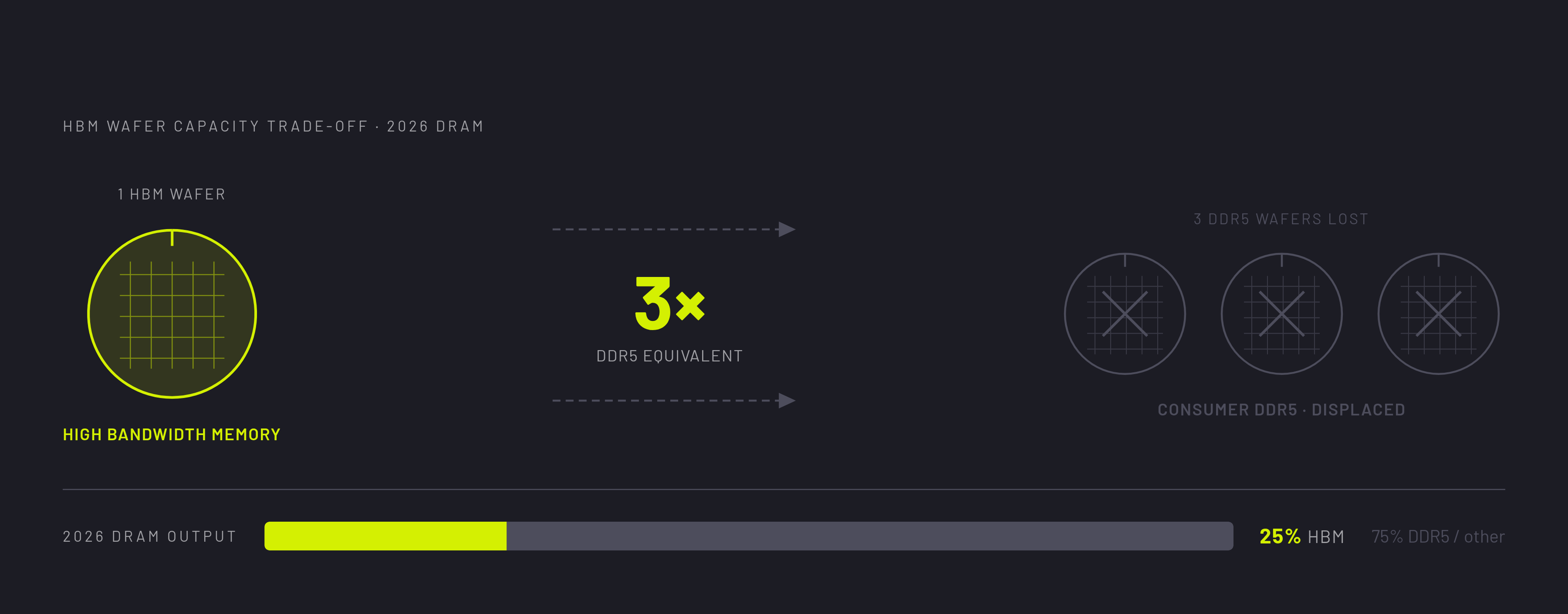
Builders who lived through 2018 or 2021 learned a simple rule: prices spike, then they come back down, so you wait. That rule depended on supply being elastic. When demand rose in those earlier cycles, manufacturers could ramp output to meet it, and once demand cooled, prices followed it back down. The 2026 surge breaks that pattern because the supply itself has been permanently reallocated, not temporarily stretched. HBM, the high-bandwidth memory that feeds AI datacenter GPUs, and consumer DDR5 are built on the same advanced process nodes inside the same fabs owned by Samsung, SK Hynix, and Micron. Every wafer a fab commits to HBM is a wafer that does not become a DDR5 kit for a gaming PC. The math behind that trade-off is stark: industry analysis puts the ratio at roughly 3-to-1, with one HBM wafer consuming the equivalent capacity of about three standard DDR5 wafers, and some estimates running as high as 4-to-1. HBM is projected to account for roughly a quarter of all DRAM wafer production in 2026, and at that ratio, consumer memory is left structurally short no matter what happens to consumer demand. Samsung, SK Hynix, and Micron are each following a plain business incentive: HBM carries fat margins from AI datacenter customers, while consumer DDR5 kits carry thin ones, so the capacity goes where the money is. SK Hynix said in October 2025 that it had already locked in demand for its entire 2026 DRAM, NAND, and HBM production, ahead of the consumer buying season for 2026. Micron's CEO has pointed to supply staying tight through 2027 and into 2028, and new fabs take at least three to five years to reach meaningful output, so the capacity decisions made back in 2024 are what determine supply through at least mid-2026. Weak consumer demand, which used to force suppliers to cut prices and clear inventory, doesn't do that here: manufacturers just ship the wafers to the enterprise queue instead. Because the constraint is structural rather than cyclical, any plan built on waiting for a correction is planning against the wrong model.
The scale and speed of the price moves
The scale of this surge is what separates it from a routine squeeze. Conventional DRAM contract prices rose sharply in the fourth quarter of 2025, then surged again in the first quarter of 2026, the single sharpest quarter on record for the tracker that follows these contracts, compounding to somewhere between roughly 2.8 and 3.0 times the starting price over just two quarters. A move of that size in six months has no precedent in the tracker's history. The clearest sign of how distorted pricing has become is a relationship that has never held before: DDR4, a memory standard several generations old, now costs more per gigabit on the spot market than HBM3e, the cutting-edge memory built for AI accelerators. Legacy memory has become more expensive than the memory doing the most advanced work in the industry, because manufacturers are winding down DDR4 production lines to free up wafer capacity for DDR5 and HBM, even as hundreds of millions of existing AM4 and LGA1700 systems still need DDR4 to run or to upgrade. Supply is shrinking while demand holds steady, so prices climb from the bottom of the market up, hitting the oldest and supposedly cheapest standard hardest of all.
PC build budgets across every tier
The surge has redrawn what every budget tier can actually buy, and it has not landed evenly. System memory's share of a total PC component bill has risen sharply in 2026 compared with 2025, so a builder spending the same total amount as a year ago now gets meaningfully less out of every other component, because memory is eating a bigger piece of the same budget. That pressure falls hardest on builders at the low end, where a fixed dollar amount has the least room to absorb a cost spike, while mid-range and enthusiast builders are hit by a second, simultaneous squeeze on GPU pricing that many did not see coming. Builder behavior reflects the strain: a Tom's Hardware survey found 60% of PC gamers have no plans to build a new PC in the next two years, citing inflated prices for RAM, SSDs, and graphics cards. Motherboard shipments from the four largest Taiwanese manufacturers are projected to fall sharply in 2026 as new-build activity dries up alongside that sentiment. Prebuilt systems have looked like an escape from all of this, but that shelter is temporary. OEMs including Dell and HP typically buy memory in bulk roughly a year ahead of demand. That is why prebuilt pricing held mostly steady while kit prices on the open market roughly tripled. Those advance-purchased inventories are starting to draw down, and restocking at current contract prices is already showing up as planned increases: Lenovo, Dell, HP, Acer, and ASUS have all flagged price hikes to come, and some are already shipping configurations with less storage to keep headline prices looking stable. The window that made prebuilts a shelter is closing rather than opening, so waiting for them to become the better deal is a losing bet right now.
The Steam Hardware Survey and the installed base's direction
Market pricing only tells half the story. What builders and gamers are actually running tells the rest, and Valve's Steam Hardware Survey from September 2026 shows the installed base moving toward higher memory configurations even as prices climb against that trend. For the first time in the survey's history, 32GB of system memory took first place as the most common configuration among Steam users, pulling ahead of 16GB, which has slipped into second. This did not happen gradually: it appears as a sharp shift within a single survey period, consistent with either OEM prebuilts shipping more memory as standard or gamers front-loading purchases ahead of further price increases, or some mix of both. On the graphics card side, the 16GB VRAM tier now holds the largest single share of surveyed GPUs, and the trend in that data points to 12 to 16GB as the sensible minimum for anyone buying a new GPU in 2026. None of this is a bar a builder is required to clear. It is a signal of where the platform as a whole is heading, and it reframes the practical question from "how much RAM do I need" into "how much RAM is the ecosystem already assuming." A builder who targets 16GB of system memory and an 8GB graphics card to save money today is building to a spec the installed base is already moving past, and doing it at the exact moment when adding memory later will cost more, not less. Community purchasing data like this, rather than any single vendor's sponsored benchmark chart, is what actually shows where real build decisions are landing.
Platform selection as the first and most consequential decision a builder makes in 2026
Every build in 2026 starts with a decision that used to feel secondary: which socket, because the socket decides the memory standard before it decides anything about CPU or GPU. Intel's LGA1851 platform, built around the Core Ultra 200S processors, and AMD's AM5 platform both require DDR5. Neither current-generation platform supports DDR4 at all, so any builder starting on a current CPU is on DDR5 by default, with no way around it. That's where the DDR4 escape hatch comes in for budget-conscious builders: DDR4 remains substantially cheaper per gigabyte than DDR5, with a 32GB DDR4 kit running roughly one-third to one-half the price of a comparable DDR5 kit. Taking that escape hatch means committing to an older platform, AM4 or LGA1700, with no upgrade path to a current-generation CPU. AMD gave budget builders two clear entry points rather than pushing everyone onto the pricier DDR5 platform: it launched the Ryzen 5 5500F for AM4 at $99 and the Ryzen 5 7500 for AM5 on the same day, September 10, 2026. The strongest argument against treating DDR4 as a temporary stop-gap is that there is no cheap route from AM4 to AM5 later. Buying AM4 now and planning to switch once prices settle means the platform decision has already been made, because moving to AM5 afterward requires a full replacement of motherboard, CPU, and memory, which costs more in total than committing to DDR5 from the start. DDR4 is also not a stable place to wait, since manufacturers are actively winding down its production to redirect wafers toward DDR5 and HBM. The DDR4 price inversion described earlier is the direct result of that shrinking supply running into steady demand from the installed base, and it's positioned to get worse. At lower budget levels as of September and October 2026, AM4 tends to win out, because what a builder saves on motherboard and memory can go straight into a stronger graphics card. At higher budget levels, AM5 absorbs its premium easily and comes with a real upgrade path to future CPUs that AM4 no longer offers.
The levers a builder controls when prices are set by forces outside the market
None of the forces described above are within a builder's control: not the wafer allocation decisions Samsung, SK Hynix, and Micron made back in 2024, not the HBM demand coming out of AI datacenters, and not the timing of when prebuilt inventories run dry. What a builder can control is how they respond to those forces, and a few moves make a real difference. Buying the right amount of memory now, rather than the bare minimum, is worth doing because the Steam data shows 32GB as the new baseline and because upgrading later is highly likely to cost more than it does today, making capacity front-loading one of the rare timing calls that clearly favors acting sooner. Choosing DDR4 should be treated as a deliberate, multi-year platform commitment rather than a temporary bridge, so anyone building on AM4 to save money should plan to keep that system largely as-is for several years instead of expecting a cheap upgrade path to AM5 down the line. The prebuilt window deserves watching closely, because the OEM price hikes already flagged by Lenovo, Dell, HP, Acer, and ASUS mean the period when prebuilts were shielded from spot-market pricing by advance purchasing is ending, and builders who can plan and buy quickly are in a stronger position than those waiting for OEM pricing to settle down. On the graphics card side, since memory accounts for more than 80% of a GPU's bill-of-materials cost, stepping down a performance tier to land on a 16GB card instead of a faster 8GB one is likely to hold up better over time, since the 8GB card is the one more likely to age out of recommended specs first. One more variable sits outside any builder's planning horizon: a federal antitrust lawsuit filed in June 2026 against Samsung, SK Hynix, and Micron alleges coordinated supply restriction and price inflation, and a material development in that case could shift the pricing picture, but litigation on that scale runs for years and isn't something a build plan today should depend on. What all of this comes down to is matching current, real prices against a specific build before committing money, since a wrong component choice costs more in a market like this than it ever has before. Tools that let a builder compare prices across retailers in real time, check compatibility, and estimate FPS for a complete build, with current pricing locked in before a single part ships, are built for exactly this kind of market, where prices move faster than the usual research cycle a builder would normally rely on.