Supply Chain Transparency and What Builders Are Never Told
AI demand for memory and chips is reshaping what PC builders can actually afford.
Component prices hide the decisions that shape a PC build long before checkout. Supply chain transparency matters because choosing parts well now means knowing why they cost what they do. In 2026, a sensible build starts with an understanding of scarce memory, competing factory orders, and the limits of planning tools.
Why the price tag on a component tells you almost nothing about what it actually costs to make
A number in a cart tells you what a retailer wants. Behind that number sit fabrication constraints, geopolitical redirections, and margin decisions made before the part reached the shelf. The price compresses those decisions into something that looks simple. The price can mislead because different pressures can push it just as high.
Most build guides take price as a starting condition and then look for the best parts within it. That is useful for comparing what is available, but it leaves the cause unexplained. Without that cause, a builder cannot judge whether waiting, substituting a part, or revising the whole build makes sense.
How AI infrastructure captured the factories that make consumer PC parts
Samsung, SK Hynix, and Micron control most of the global DRAM market. All three have redirected wafer capacity toward high-bandwidth memory, or HBM, for AI accelerators. HBM commands higher margins and faces heavy demand from hyperscalers. Consumer memory therefore competes for production space against products that offer manufacturers a better return. This is not simply a shortage caused by more people wanting RAM.
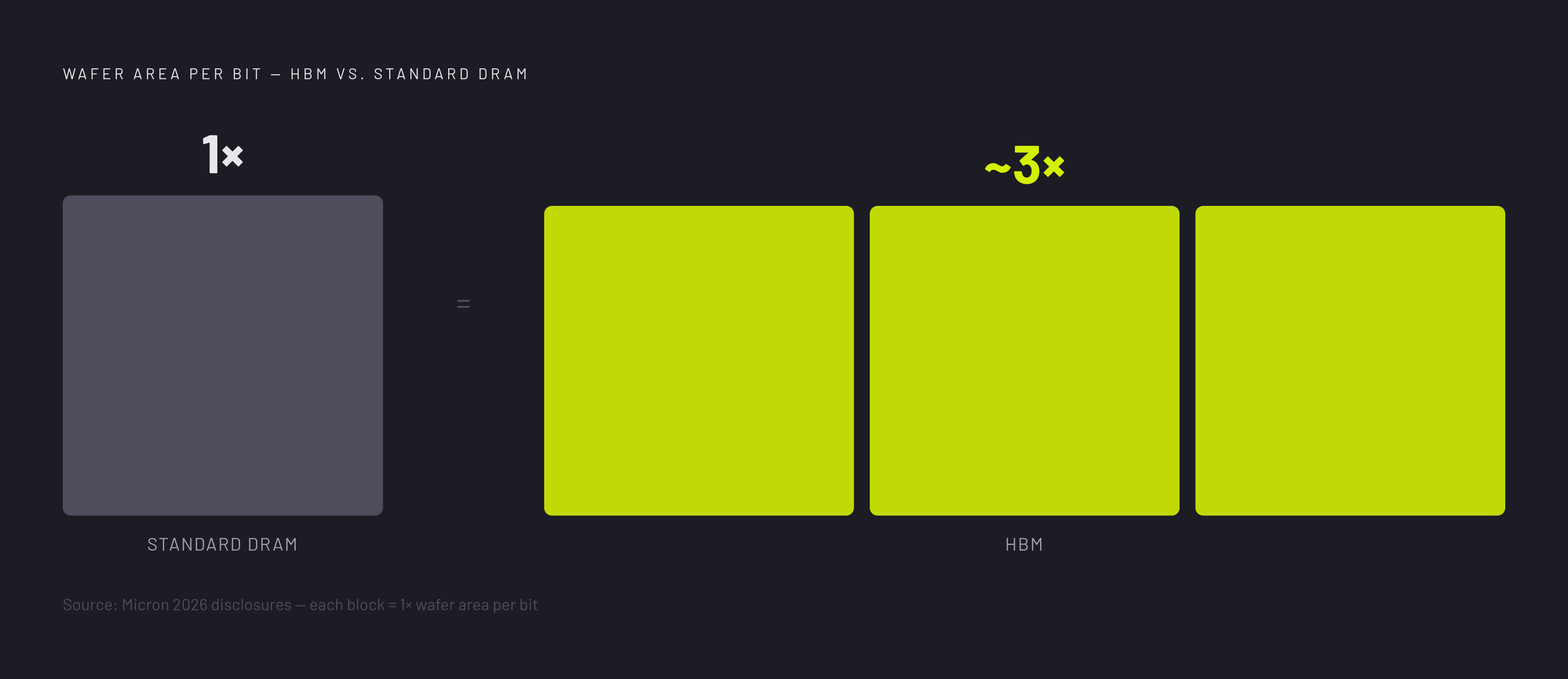
Micron’s 2026 disclosures put HBM’s wafer requirement at roughly three times that of standard DRAM per bit. Moving production toward HBM therefore consumes more capacity than a simple exchange between two memory products might suggest. The memory attached to an AI accelerator takes factory space that could otherwise be used to make consumer memory. A change in the order book becomes a constraint on what builders can buy.
Advanced logic faces a similar contest. TSMC manufactures over 90% of the world’s advanced logic chips, and its leading-edge nodes are heavily booked by Apple, AI accelerator makers, and hyperscalers designing custom silicon. Finished chips also need packaging, including TSMC’s CoWoS and Intel’s EMIB and Foveros technologies for chiplet designs. AI GPU demand strains CoWoS capacity, so making more wafers alone would not remove every bottleneck. AMD warned in May 2026 that higher memory and component costs would affect gaming demand in the second half of 2026, showing how upstream pressure reaches the consumer business.
What the supply chain looks like beyond the fab — materials, PCBs, and the inputs no one warns builders about
The factory making a chip is only one stop in the chain. A finished component also depends on materials, circuit boards, packaging, and logistics, each with its own constraints. Even when one production bottleneck eases, the product as a whole may still cost just as much to supply. The remaining inputs still have to reach the right place.
Chinese export controls on rare earths and the U.S.-Iran conflict add pressure outside chip fabrication. Roughly a fifth of global crude oil moves through the Strait of Hormuz, tying disruption there to transport and petrochemical inputs such as plastic. Those costs have little to do with how many people want a new gaming PC. Yet they sit upstream of products those people buy. A price increase on a motherboard is not necessarily evidence of stronger motherboard demand, and treating it that way gives builders the wrong explanation for what might happen next.
What Micron's exit from the consumer market actually reveals about how RAM is made and sold
Micron said it planned to wind down its Crucial consumer brand worldwide by the end of February 2026. It said it would shift toward enterprise-grade DRAM and SSD products as AI demand grew. That removed a familiar consumer option, but the more important distinction is what did not disappear. Micron continued making memory chips while closing the Crucial route through which people could buy consumer products with its brand on them.
A RAM brand and a DRAM manufacturer are not the same thing. The name on a kit identifies the consumer product, but it does not necessarily identify the company that fabricated the chips inside it. G.Skill, Kingston, and TeamGroup kits draw on the same small group of underlying manufacturers, principally Samsung, SK Hynix, and Micron. Some Kingston and TeamGroup kits may also contain chips from emerging Chinese manufacturers such as CXMT or YMTC.
A different kit may face the same supply constraints as the first one. Crucial also provided consumer-facing price competition in RAM and SSDs, so its departure removes more than packaging from a shelf. It reduces one source of competitive pressure on the underlying manufacturers. Meanwhile, older guides still recommend Crucial products that are no longer available, making it look as though buyers have choices they no longer have.
How GPU supply constraints work in practice — and what NVIDIA's RTX 50-series allocation decisions show builders
GPU availability depends on more than the supply of graphics chips. A card also needs memory, and a shortage there can limit shipments even when the product remains part of the range. That distinction matters when a missing model looks like a deliberate change in product strategy. The constraint may instead sit in the parts needed to finish the card. What reaches retail is an allocation outcome as well as a product decision.
ASUS made that connection explicit when discussing the RTX 5070 Ti and RTX 5060 Ti 16GB. ASUS stated that “Current fluctuations in supply for both products are primarily due to memory supply constraints”. The statement did not specifically identify GDDR7 allocation, so it does not support treating that narrower explanation as established. It does show that the supply of some RTX 50-series cards can depend on how much memory is available. A GPU tier is not insulated from the same memory pressures affecting the rest of the build.
For builders, choosing VRAM capacity now means weighing both performance and what the budget can buy as supply changes. HBM and GDDR allocation decisions help shape which cards are available and what they cost. At the same time, 8GB cards are getting punished at resolutions above 1080p. That makes 12GB the least to aim for and 16GB the smarter buy above entry level for a build meant to last several years. A cheaper card is not automatically a useful substitute if its memory capacity undermines that plan.
Why prebuilt systems now absorb cost pressure that individual buyers cannot
Changing the shopping route can change who absorbs the supply chain’s pressure. Commercial system builders negotiate volume prices and hold inventories that an individual buyer cannot match. Notebook builders have stocked up to avoid paying more later, while some manufacturers absorb the extra costs themselves. Someone buying one memory kit from a retailer can do neither. The price of separate parts and the price of a complete system can therefore respond differently to the same upstream squeeze.
Does that mean giving up on DIY is the sensible answer. No, but self-assembly no longer carries a reliable promise of saving money in 2026. Its case rests more clearly on customization, visual planning, and learning the build. Asus, Gigabyte, MSI, and ASRock have all cut their 2026 motherboard unit forecasts significantly as builders switch to prebuilt systems or wait, a structural demand signal.
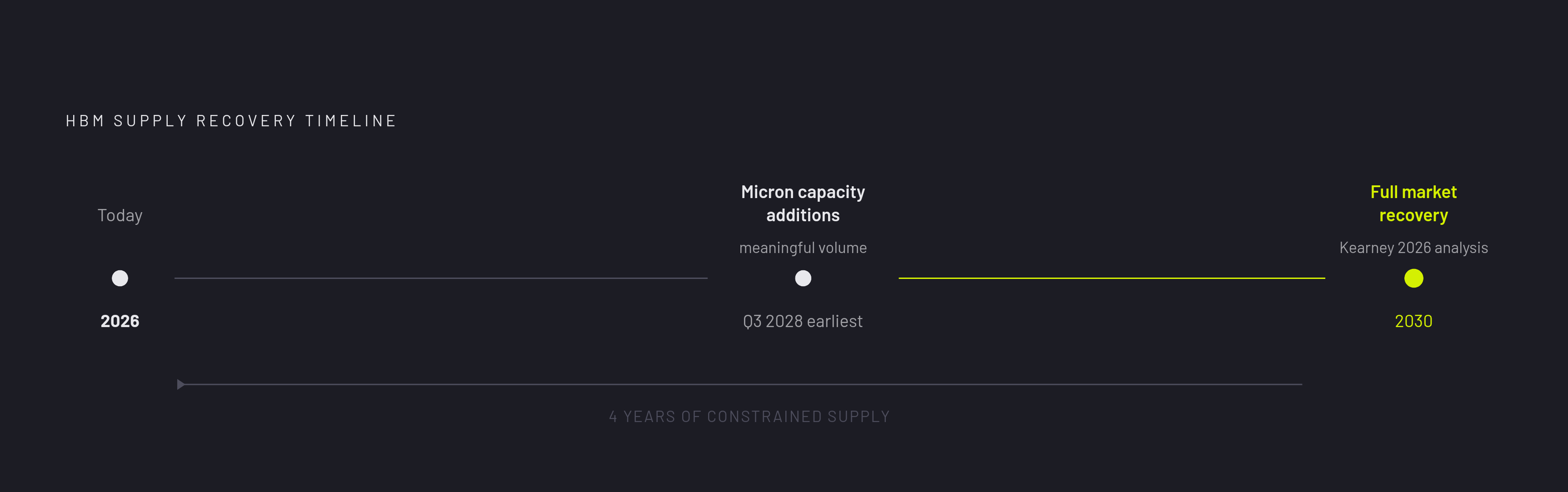
Waiting also needs an honest time horizon. Kearney’s 2026 market analysis puts a full recovery as far out as 2030. Micron’s capacity additions will not deliver meaningful volume until the third quarter of 2028 at the earliest. Those timelines make “wait for normal prices” an unreliable short-term build plan.
What compatibility checkers and build guides don't catch — and what that costs builders who don't know to look
Price is not the only place where a clean answer can hide missing information. Standard compatibility checkers reliably catch CPU socket mismatches, RAM type incompatibilities, power connector requirements, and most size conflicts. But those checks do not automatically establish that a CPU cooler clears tall RAM heat spreaders. The heat spreaders can physically block the base of some tower coolers. A parts list can pass its broad checks and still leave a fit problem unresolved.
Memory validation is another separate check. A motherboard manufacturer’s Qualified Vendors List, or QVL, records which RAM kits it has validated, with kit coverage varying by board. Skipping that check risks instability in the system weeks after first boot, even if the system passes its first startup test. Matching the RAM type is not the same as checking validation for the specific kit and motherboard.
Power planning also needs more detail than a budget checklist may provide. Most RTX 5000-series GPUs use a 12V-2×6 connector, while the RTX 5060 and RTX 5060 Ti use a standard 8-pin connector. A power supply with a native 12V-2×6 port is preferable, but supported adapters from standard 8-pin cables are also an option. A suitable power supply can still be kept if it meets the requirement. Conversely, saving a small amount on a generic unbranded unit is a budget-build mistake with a serious risk of hardware damage.
Other planning gaps come from age or approximation. Guides written for 2023–2024 conditions still appear in search results in 2026, including those that recommend Crucial drives that are no longer made. Airflow simulations have a different limit because their results depend on fan size and speed, filters, vents, radiators, and exact mounting positions. Real temperatures can only be established after assembly.
How to plan a build in 2026 with the supply chain's blind spots in view
Start with memory and GPU VRAM. RAM prices and GPU memory allocation are among the most volatile, supply-constrained parts of the decision, so settling those first gives the rest of the build a firmer boundary. Then choose the rest of the system to fit that memory capacity and graphics option, how long the build needs to last, and what it can cost.
As part of compatibility planning before buying RAM, check the specific kit against the specific motherboard’s QVL. Cross-reference a guide’s recommended parts with current retailer availability before relying on its budget or substitutions. A guide still presenting Crucial as an available option is working from outdated assumptions.
Finally, visualize the build in three dimensions before committing to the parts. Visual, interactive planning can help show where a cooler needs more clearance, where parts will not fit in the case, or where airflow conflicts arise that a basic compatibility result misses. It remains a planning aid rather than a guarantee of temperatures, but catching a conflict before purchase can avoid a return or a second order. That is the practical value of supply chain awareness. It turns a parts list from a set of attractive specifications into a buying plan that accounts for what the price tag leaves out.