How New GPU Generations Reshape Mid-Range and Budget Tier Pricing
Memory shortages for AI chips are reshaping GPU pricing across every tier at once.

A lot of builders are sitting on the same assumption: wait for the new generation, and prices will settle back down once the hype clears. That assumption built on a cycle that held for years, but it has broken in 2026. Prices are climbing across every price tier at once because the physical supply of memory chips that go into these cards is shrinking, even though buyers are not rushing to grab cards the way they did during a mining boom. A new GPU generation used to reset the entire price ladder: the flagship set a new ceiling, the previous generation's mid-range cards dropped to stay competitive, and budget buyers picked up whatever fell out the bottom. That ladder depended on manufacturers having enough memory to build cards at the volume and price points the market expected. In 2026, that supply assumption no longer holds, and the cascade that builders have learned to wait for simply has not shown up on schedule.
How the memory shortage reaches retail prices
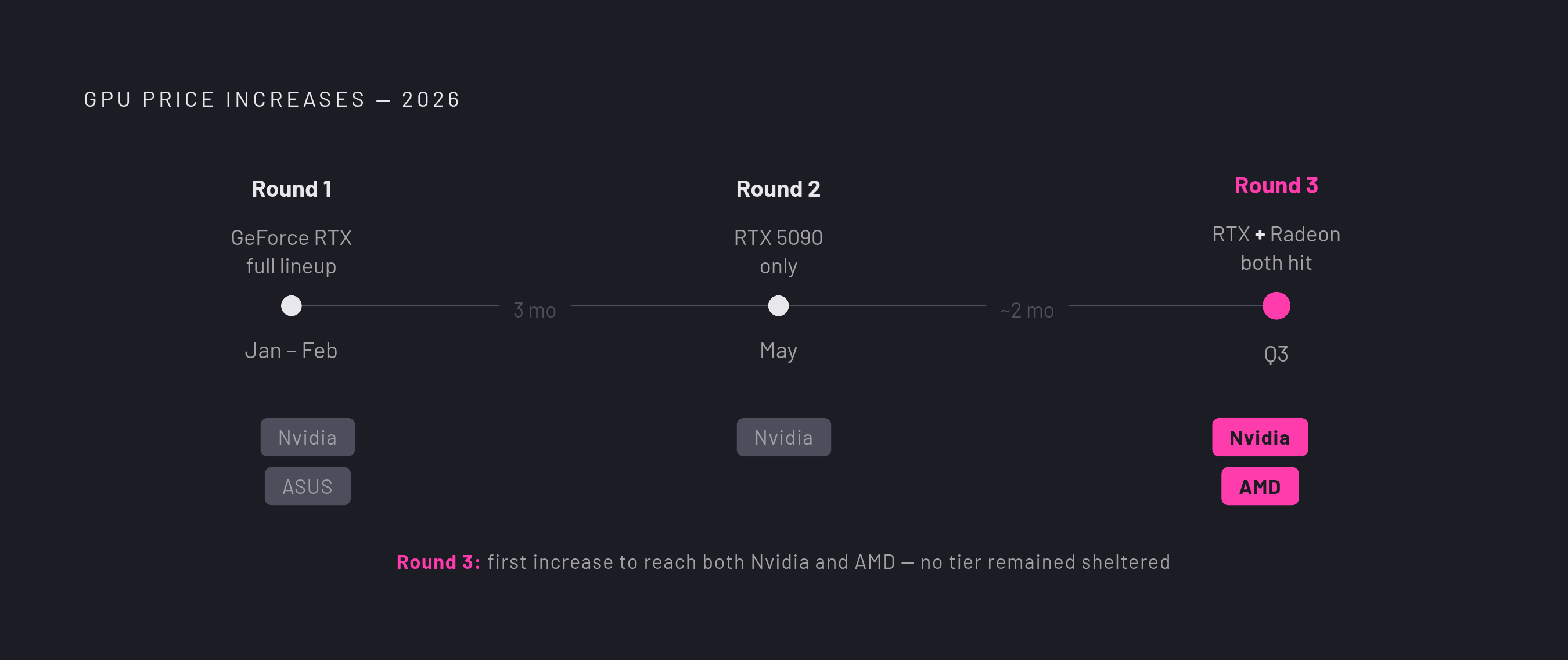
AI data centers need the same GDDR7 and GDDR6 memory that gaming GPUs use, and Samsung, SK Hynix, and Micron, the companies that make that memory, are steering wafer capacity toward HBM for AI accelerators instead, because HBM carries far better margins. That reallocation is visible not as a single price jump but as a series of increases spread across the year, each one nudging the market a little further from where builders expect it to sit. The first round hit in January and February, when board partners like ASUS raised prices and Nvidia followed with higher kit prices across the GeForce RTX lineup. A second round in May targeted the RTX 5090 specifically. A third round arrived in the third quarter, touching RTX models and AMD's Radeon cards at the same time. None of these increases applied evenly. Some cards barely moved. Others climbed steeply, and the steepest climbs did not land where most people would expect.
Why mid-range cards absorbed the steepest percentage increases
The instinct is to assume that flagship cards, the ones already priced for enthusiasts, would take the brunt of a supply squeeze. That is not what happened. The mid-range tier, where most PC builders actually shop, absorbed the largest percentage increases of this entire cycle. That is a real departure from the last major shortage, in 2020 and 2021, when mid-range cards like the RTX 3060 Ti commanded high premiums because miners prized their efficiency, even as high-end cards also got hit hard by scalpers and crypto demand. This time, Tom's Hardware's tracking of median RTX 50-series listings on Newegg between June and August 2026 found the RTX 5060 Ti 16GB, a card built for 1440p gamers rather than anyone chasing benchmark records, posted the steepest jump in the entire lineup. The RTX 5070 climbed sharply over the same stretch, pushing a card that launched at a mainstream price well above where it started by September 2026. Flagship pricing and mid-range street pricing are compressing toward each other, the clearest signal in this entire cycle. Once a mid-range card costs nearly as much as the flagship sitting one tier above it, the whole reason to step down the stack for value starts to fall apart. The exposure makes sense once you look at what these cards are built from. Mid-range cards use the same GDDR7 memory as the flagships sitting above them, but their margins are thinner in absolute dollar terms, so the same dollar increase in memory cost eats up a much larger share of the card's total price.
How flagship launch pricing redefines "mid-range" for builders
A new flagship does more than set the top of the market. It resets how every other card in the lineup gets talked about, bought, and compared. A card that would have been called high-end in the previous generation gets mentally filed as "mid-range" once a new, far more expensive flagship launches above it. That is what has happened with the RTX 5080, which sits well above its own launch MSRP at retail, and the RTX 5070 Ti. Both now get treated as the "reasonable" choice next to the RTX 5090, even though by the standards of the prior generation, both would be considered expensive enthusiast hardware in their own right. Builders need to catch themselves doing this and push back against it. The only fair comparison for any card is its own launch MSRP and what it delivers against other cards selling at the same street price, not its distance below a flagship that costs multiples more. Losing sight of that comparison is how a shopper ends up convincing themselves a pricier card is a bargain simply because a far more expensive card exists above it. A 3D configurator with real-time price comparison, like the one BuildCores offers, makes this easier to catch, because it shows the full cost of a build rather than just a GPU's sticker price, and tier compression becomes obvious once you see total build cost side by side rather than isolated line items on a spreadsheet.
What happens to previous-generation cards in an inflated market
Builders who have been through a few upgrade cycles know the standard play: let the new generation launch, then buy the previous generation's mid-range card once its price drops to compete. That play depends on the previous generation having room to fall, and in 2026, the same memory cost pressure squeezing new cards is limiting how far older cards can drop. In some cases, it is pushing them back up instead. There was a real window early in the year when this strategy worked, and builders who moved during it got genuine value out of older silicon before the broader cost pressure caught up with it. That window did not last. AMD notified its board partners of a Radeon kit price increase of at least 10 percent effective August 2026, with the exact increase varying by model, and that move erased whatever price gap had opened up between Radeon and GeForce cards at comparable performance levels. The competitive pressure that should have pushed prices down instead got swallowed by the same supply-side cost increase hitting everything else. The lesson here is about timing, not strategy failure. Buying last generation for value still works, but the window between a new generation's launch and the point where rising memory costs catch up to older cards is short, and in 2026 that window has mostly closed.
How budget-tier builders absorb the cascade
The bottom of the market feels every part of this cascade, just later than everyone else, and with fewer ways to respond when it arrives. Three forces are converging there at once: memory supply getting redirected toward AI hardware, AIB partners cutting back production of cheap cards, and the previous generation's budget options repricing upward. MSI confirmed it is scaling back production of its cheaper gaming hardware to redirect resources toward mid-range and high-end products instead. PC Partner has warned that entry-level cards face even more severe shortages specifically in the second half of 2026. Into that gap stepped an option few people were counting on at the start of the year: Intel's Arc Battlemage lineup, and specifically the Arc B580, which settled at $250 and stayed in stock while competing cards climbed well above their own MSRPs. That is genuine scarcity value in a market where availability itself has become the scarce resource, but the B580's driver maturity and software ecosystem still lag behind Nvidia and AMD, so anyone buying it should weigh those trade-offs carefully. What makes the B580's position interesting is less the card itself and more what it reveals: the supply pressure opened a gap in the market, and Intel filled it when the two established players could not. For builders shopping at this tier, where even a modest difference between retailers can change which card fits a budget at all, a compatibility checker and multi-retailer price comparison, the kind built into BuildCores' configurator, catches the common mistake of picking a card that technically fits the budget but doesn't pair well with an existing case or power supply.
Builder response to frozen pricing, per the Steam Hardware Survey
Theory and pricing tables only tell part of the story. What builders are actually running in their machines tells the rest, and the Steam Hardware Survey is the clearest window into that. The data shows upgrade cycles frozen in place by elevated pricing, alongside a shift in the VRAM level that the active gaming population has already settled above. Both facts should shape how and when builders buy. The Nvidia GeForce RTX 3060, a card that launched in early 2021, remained Steam's most-used GPU as of August 2026. Millions of gamers staying on five-year-old silicon is a sign that pricing, not preference, is keeping them there. The consequence for anyone shopping today is direct: buying an 8GB card now means buying below the VRAM level the installed base has already moved past, and that shortens the card's useful life no matter how well it benchmarks on release day. Nvidia's dominance of that installed base over AMD and Intel matters beyond raw performance comparisons too, since it shapes which cards get the most driver support, the most game-specific optimization, and the largest community troubleshooting base when something goes wrong. This is the kind of real purchasing data worth watching instead of marketing copy, the same kind that BuildCores' own monthly hardware surveys are built to surface.
Reading the current GPU tier map and deciding when to buy at each budget level
None of this points toward a single, uniform answer for every builder. It is not "wait indefinitely" and it is not "buy today no matter the price." Each budget tier carries its own math, and the right move depends on matching the timing decision to where you're actually shopping rather than treating the GPU market as one undifferentiated block. On the "buy now versus wait" question, the sources point to a specific horizon: memory supply is not expected to meaningfully normalize until late 2027 at the earliest, with many in the industry pointing to 2028 instead. That means further price increases before the fourth quarter of 2026 are more likely than not. Waiting only makes sense for a builder who can genuinely defer the purchase for 12 months or more and live with current performance in the meantime. For builders evaluating specific cards against a budget, a tool that updates with live prices rather than a static chart lets them see how the market has moved from month to month before committing to a purchase. BuildCores' real-time price comparison, paired with FPS estimates through 3DMark integration, lets a builder drop in a card like the RX 9060 XT 16GB or the RTX 5060 Ti and see immediately how the total build cost and expected performance shift, rather than working from numbers that were already stale by the time they were published.
The 16GB VRAM floor for builds planned today versus 2024
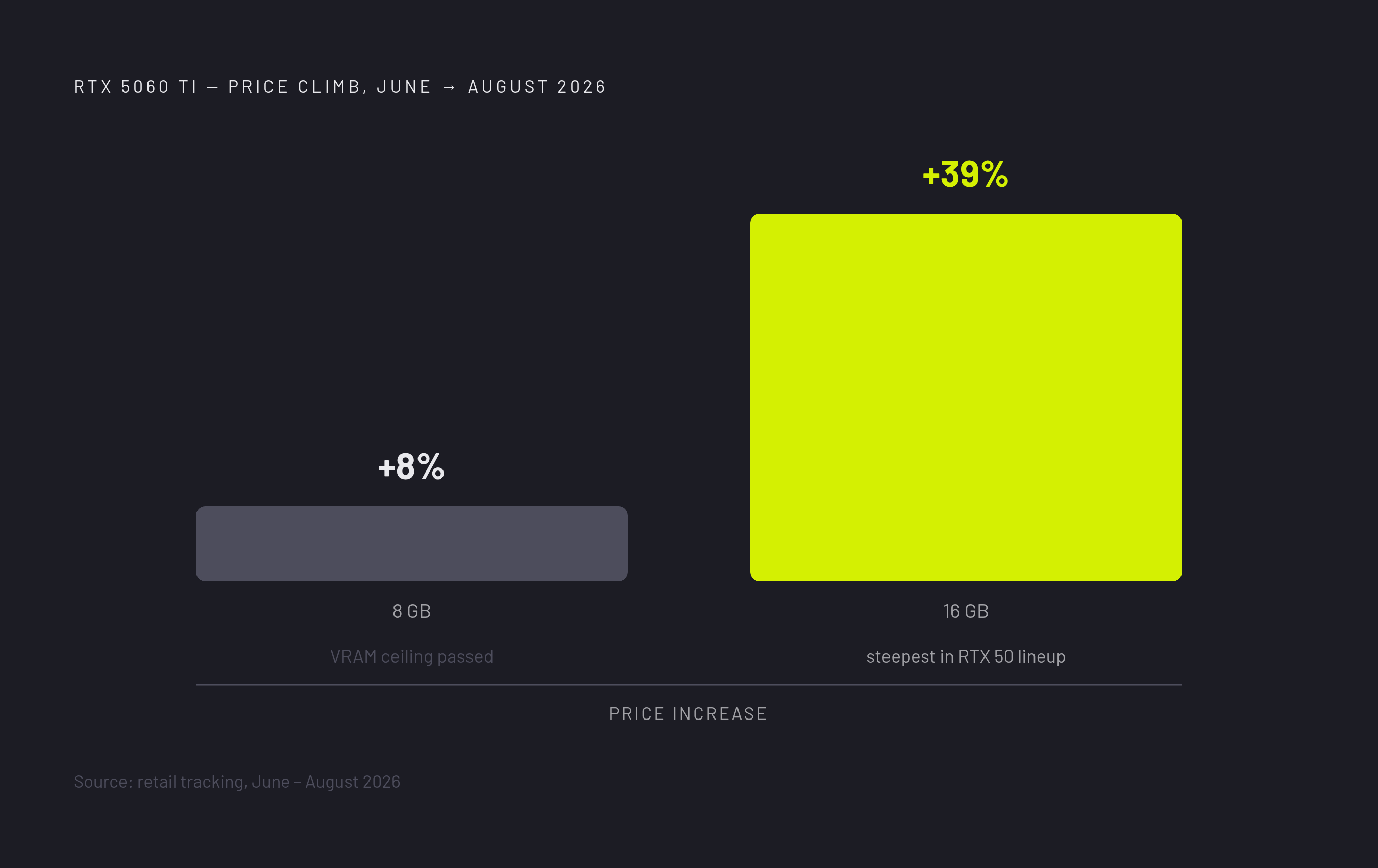
If there is one rule to carry out of this entire cascade, it is this: the case for buying an 8GB card is finished. The majority of the Steam installed base has already moved past 8GB, and the price relief that should have made 8GB cards the easy budget pick instead made 16GB cards the new mainstream floor. The RTX 5060 Ti makes this concrete. Its 16GB version posted a 39 percent price increase between June and August 2026, the steepest jump anywhere in the RTX 50 lineup, while the 8GB version remains available for meaningfully less money but carries a VRAM ceiling that puts it behind where the installed base is already headed. The planning rule that follows is simple: at every tier above true entry-level, prioritize the 16GB variant when one exists, even if that means trimming a dollar or two from another part of the build to stay on budget. This is about how long the card stays useful before it becomes the bottleneck in a system that is otherwise fine, not just about day-one frame rates. Seeing a build in 3D before buying it, in a configurator like BuildCores that combines real-time pricing, compatibility checks, and performance estimates in one place, is how a builder catches the mistake this cascade keeps setting up: a GPU that fits the budget today but sits below the VRAM line the gaming community has already crossed.