Intel's Foundry Ambitions and What They Mean for the PC Builder Ecosystem
Intel's foundry success will determine whether desktop CPUs in 2027 are competitive or expensive.
A builder deciding today between an Arrow Lake system and waiting for Nova Lake is, whether they know it or not, making a bet on Intel's foundry. The CPU they will buy in 2027 is being manufactured on the same production lines Intel is using to court Google, Microsoft, and Tesla as contract manufacturing customers. Foundry outcomes flow directly into desktop CPU supply and pricing.
Since 2021 Intel has pledged over $100 billion toward manufacturing expansion, with new fabs in Arizona and Ohio anchoring it. The node at the center of this gamble, Intel 18A, is also the node manufacturing the CPU cores in Panther Lake, Intel's most recent product family. The foundry's health and the consumer silicon roadmap are the same story.
What Intel 18A actually is and why it marks a structural shift in how Intel makes chips
Intel 18A is the first production node in Intel's history to combine RibbonFET gate-all-around transistors with PowerVia backside power delivery, and it is the first node in the industry to implement backside power delivery in production. Backside power delivery physically reroutes the power grid to the underside of the chip, freeing routing layers on top for signal wires. The result is measurable area reduction and lower voltage droop, both of which feed directly into frequency headroom and power efficiency.
At the 2026 VLSI Symposium, Intel Foundry confirmed that Intel 18A-P, the first performance enhancement in the 18A family, has entered risk production on the timeline previously shared with customers and partners. For builders, the significance is straightforward: Intel credits the 18A process with a gain in efficiency and density versus its previous-generation Intel 3 process. The manufacturing improvement is what enables a more competitive product, not just a faster design team.
How yields determine whether technical progress translates into chips builders can actually buy
If a technically impressive node is not economically viable, the single variable deciding that is yield: the share of usable chips from each wafer. KeyBanc Capital Markets estimated 18A yields at roughly 55% in mid-2025, so Intel appears to have entered 2026 with yields near commercial competitiveness. TSMC's nodes, however, have historically reached profitable yields sooner and more consistently.
Intel CEO Lip-Bu Tan stated publicly that yield improvement is now tracking at the healthy industry-standard pace of roughly seven to eight percent per month, a rate he said he was not seeing when he took over. Intel Foundry lost roughly $7 billion in 2023, and it kept losing billions through 2024 and 2025. Q1 2026 operating loss improved $72 million quarter-over-quarter. Meaningful directionally, but the gap to profitability remains wide. Intel CFO David Zinsner told analysts that Panther Lake gross margins are improving but remain below corporate average, and it will take multiple quarters before Panther Lake reaches foundry-average gross margins. Intel is shipping real products but absorbing a cost penalty on each wafer, which has direct implications for how aggressively it can price CPUs built on 18A.
Why the foundry's customer roster matters for CPU supply — and what the current roster actually looks like
A foundry running primarily on internal volume cannot build the BKM, the accumulated process knowledge from running diverse customer designs, fast enough, so it cannot close the gap with TSMC. Microsoft has confirmed a collaboration on custom AI silicon, and AWS is partnering with Intel on a custom AI fabric chip initiative on Intel 18A. Neither Microsoft nor AWS has confirmed production on 18A.
Tesla is working with Intel on its 14A process node, including evaluating Intel's 14A Process Design Kits, as part of its "Terafab" AI chip project. Intel CEO Tan said in May 2026 that Intel expects commitments from multiple foundry customers in the second half of the year, a signal that the pipeline is advancing from exploratory to contractual. That has not yet materialized into announced volume.
Intel's 18A PDK, released in mid-2024, has accumulated over 100 tapeouts, but its Model-to-Hardware Correlation, the accuracy of simulation versus actual silicon behavior, remains far from the validated depth TSMC has built over decades. A customer whose chip underperforms against simulation does not return.
The structural moat TSMC holds and why closing the gap takes longer than a node announcement
The core barrier Intel faces is not any single technology but the compounding effect of decades of process knowledge, IP ecosystems, and customer trust that TSMC has accumulated. The accuracy of those models is built by running thousands of customer designs over years, not months. Intel's 18A PDK has over 100 tapeouts against TSMC's thousands of silicon-validated IP blocks registered across decades.
Second, Best Known Methods: the optimized parameter combinations for every step in an advanced process are learned by running wafers at scale across diverse designs. TSMC's volume advantage means its BKM compounds faster than Intel's can at current external customer levels. As TSMC's Arizona fab and Samsung's Taylor, Texas plant release advanced-node capacity, the geopolitical premium of domestic U.S. manufacturing that currently gives Intel a structural advantage will be diluted.
Intel's own SEC filings have said in risk language that external customer volume remains limited. The challenge is structural, not merely a matter of trust: the company invested heavily without sufficient demand, and the absence of external volume at scale on any node has not yet been remedied. Technical milestone achieved and viable foundry business are different claims.
Panther Lake's role as the foundry's first proof-of-concept that reaches consumers
Panther Lake, the Core Ultra Series 3, is the first consumer product manufactured on Intel's 18A process node, so it is the foundry's live proof-of-concept at volume. Intel announced the Panther Lake laptop family on January 5, 2026, began preorders January 6, and stated first systems would be globally available from January 27, 2026. The GPU tile uses the Intel 3 process with 4 Xe cores, with a separate, larger 12-Xe-core GPU tile built on TSMC N3E also available. That split-tile approach manages yield risk by reserving 18A for the most performance-critical component.
Panther Lake is a mobile-only product, sold as soldered BGA packages with RAM and storage as the only upgradeable elements. Its relevance to builders is indirect but real: it is the data point that either confirms or challenges Intel's yield and reliability claims before those claims are applied to socketed desktop silicon. Intel credits the 18A process with a gain in efficiency and density versus its previous-generation Intel 3 process, and the gains in Panther Lake are the empirical baseline against which the desktop Nova Lake architecture will be measured.
Nova Lake and the socket decision every desktop builder will face
Nova Lake is the first desktop platform where the foundry's progress or failure translates directly into a socketed, upgradeable CPU that builders can actually put in a case. Nova Lake desktop processors will use the new LGA 1954 socket, so they replace the LGA 1851 used by current Arrow Lake and Arrow Lake Refresh chips. The platform is expected to scale up to 52 cores and include Xe3 graphics.
The compute tile uses a mix of TSMC N2 and Intel's own 18A, with 18A now reportedly handling 80 to 90 percent of production. A longer-lived LGA 1954 socket would represent a meaningful policy change from Intel's recent history of frequent socket transitions, from LGA 1200 to LGA 1700 to LGA 1851 in rapid succession. Motherboards with LGA 1954 sockets had not been announced, and Q1 2027 is the more realistic retail date.
Why the compatibility picture between current and next-generation Intel platforms is more complex than a socket swap
The transition from current LGA 1851 Arrow Lake systems to Nova Lake LGA 1954 is not just a socket incompatibility. Nova Lake introduces 900-series chipsets, the Z990, Z970, and B960. A new motherboard is required regardless of what else changes.
The memory and lane deltas are equally consequential. If you are moving from a DDR4 or older DDR5 platform, plan memory costs into the transition. PCIe 5.0 with up to 36 lanes is part of the Nova Lake platform spec, which matters for builders running multiple high-bandwidth devices who are currently lane-constrained. The promise of multi-generation socket support with LGA 1954 is commercially important precisely because the community has been burned by short platform lifecycles before. This is exactly the kind of multi-variable compatibility scenario, spanning socket, chipset, memory type, PCIe generation, and power delivery spec, where visualizing a complete build before purchasing any component prevents costly mistakes. A builder who locks in a case, PSU, and cooler for a current Z890 board and then pivots to Nova Lake may face fitment and power delivery surprises that a planned, visual build review would surface in advance.
14A and the geopolitical floor that changes Intel's competitive position regardless of commercial outcomes
The decisive arena for Intel's foundry viability is not 18A, which launched when TSMC was already ahead. It is 14A, which Intel is designing from inception for external customers and which is intended to reach market at roughly the same time as TSMC's comparable node. Intel CEO Lip-Bu Tan stated that Intel 14A's node is further ahead in maturity, yield, and performance than 18A was at the same point in its development cycle, with continued PDK development and multiple external customers actively evaluating the technology. 14A PDK version 0.5 is available, with version 0.9 due in October 2026, and capacity will only be built with firm external customer commitments in hand. Intel 14A is also being designed to possibly incorporate High-NA EUV lithography in high-volume logic manufacturing, and if that works, it could establish real technical differentiation rather than a catch-up position. Tesla is already working with Intel on 14A Process Design Kits as part of its Terafab project, making it one of the first named external customers engaged at the design stage for the next node.
The geopolitical floor changes the risk calculus in ways pure commercial competition does not capture. Under finalized CHIPS Act terms, the U.S. government holds approximately a 10 percent passive stake in Intel, so the company is effectively a national champion, and policy interest in its foundry success goes beyond any single customer relationship. By late 2026, Intel expects to control roughly a fifth of the world's most advanced logic manufacturing capacity, which would make it the only plausible advanced-node alternative on U.S. soil. CFO Zinsner indicated the foundry is "not really investable" for external minority shareholders in the short term, but the structural combination of government backing, domestic capacity, and the 14A timeline creates a floor below which Intel Foundry is unlikely to fall even if commercial traction develops slowly. For builders, a domestically anchored, government-backed foundry is less likely to produce the kind of acute supply shock that hit the PC ecosystem during the recent chip shortage.
What this means for a builder deciding whether to buy, wait, or build for upgrade potential right now
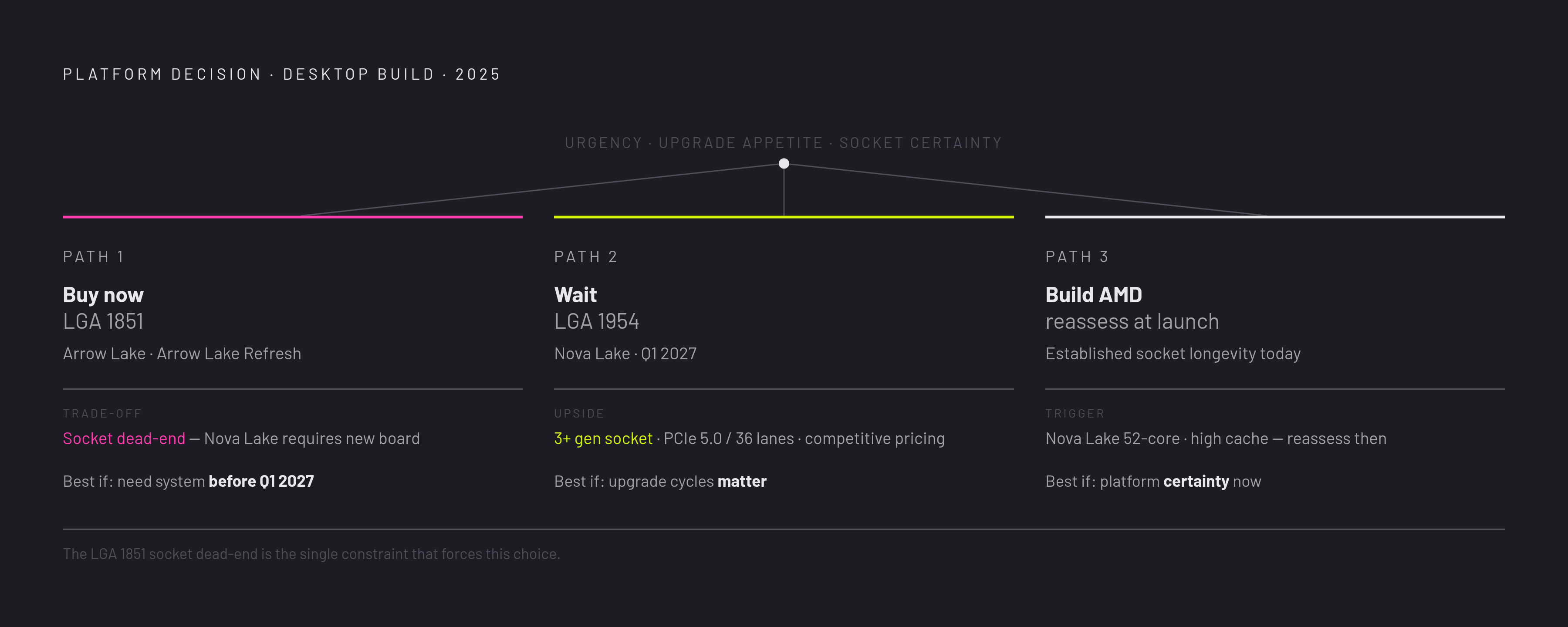
A builder's best response to Intel's foundry transition is not a single answer but a posture chosen based on budget urgency, upgrade appetite, and tolerance for platform uncertainty. Three postures emerge from the foundry analysis, each with a concrete rationale. Buy now on LGA 1851 with Arrow Lake or Arrow Lake Refresh. It is appropriate for builders who need a system before Q1 2027 or who do not prioritize multi-generation upgrade cycles. The trade-off is a known socket dead-end: no upgrade path to Nova Lake without a new motherboard.
Wait for Nova Lake on LGA 1954, targeting Q1 2027. The potential upside is a socket that may support three or more CPU generations, PCIe 5.0 with more lanes, and first-generation chips priced competitively as Intel pushes for external foundry credibility. The Tom's Hardware interview with Robert Hallock in August 2026 underscores that desktop timing should be treated as directional rather than firm.
Build AMD in the interim and reassess at Nova Lake launch. AMD's current platform offers established socket longevity, so Intel is only now promising to match it. If you want a socketed, upgradeable desktop today without betting on Intel's timeline, AMD remains a rational choice on its merits. Nova Lake's competitive arrival, if it delivers on the leaked 52-core, high-cache architecture, will be the moment to reassess.
In every scenario, the complexity of the transition makes pre-purchase planning more valuable than it has been in prior Intel generations. The foundry story also informs pricing expectations. As 18A yields improve and external customer volume grows, Intel's cost-per-chip will fall, so it can price Nova Lake more competitively at launch, especially because Intel needs to demonstrate commercial viability to the external customers it is actively courting. Understanding the supply chain means a builder can time a purchase rather than react to one.