Regional GPU Availability Asymmetry and Builder Geography
Global chip shortages push GPU access far beyond budget into pure geography.

A GPU purchase looks like a specs-and-budget problem until the buyer lives outside the United States, at which point a prior question takes over: whether the card exists in that market at all, at any price. Geography functions as the primary variable in GPU access, not a background condition that budget and patience can eventually overcome. The gap between a card's announced MSRP and its real street price in a given country, or its total absence from shelves, follows a pattern that can be mapped and anticipated. Understanding that pattern is what separates a builder who plans around the structure from one who keeps getting surprised by it. What follows lays out the mechanism, the evidence for it, and what a builder outside the US can do once the mechanism is understood.
The US-Centric Allocation Waterfall
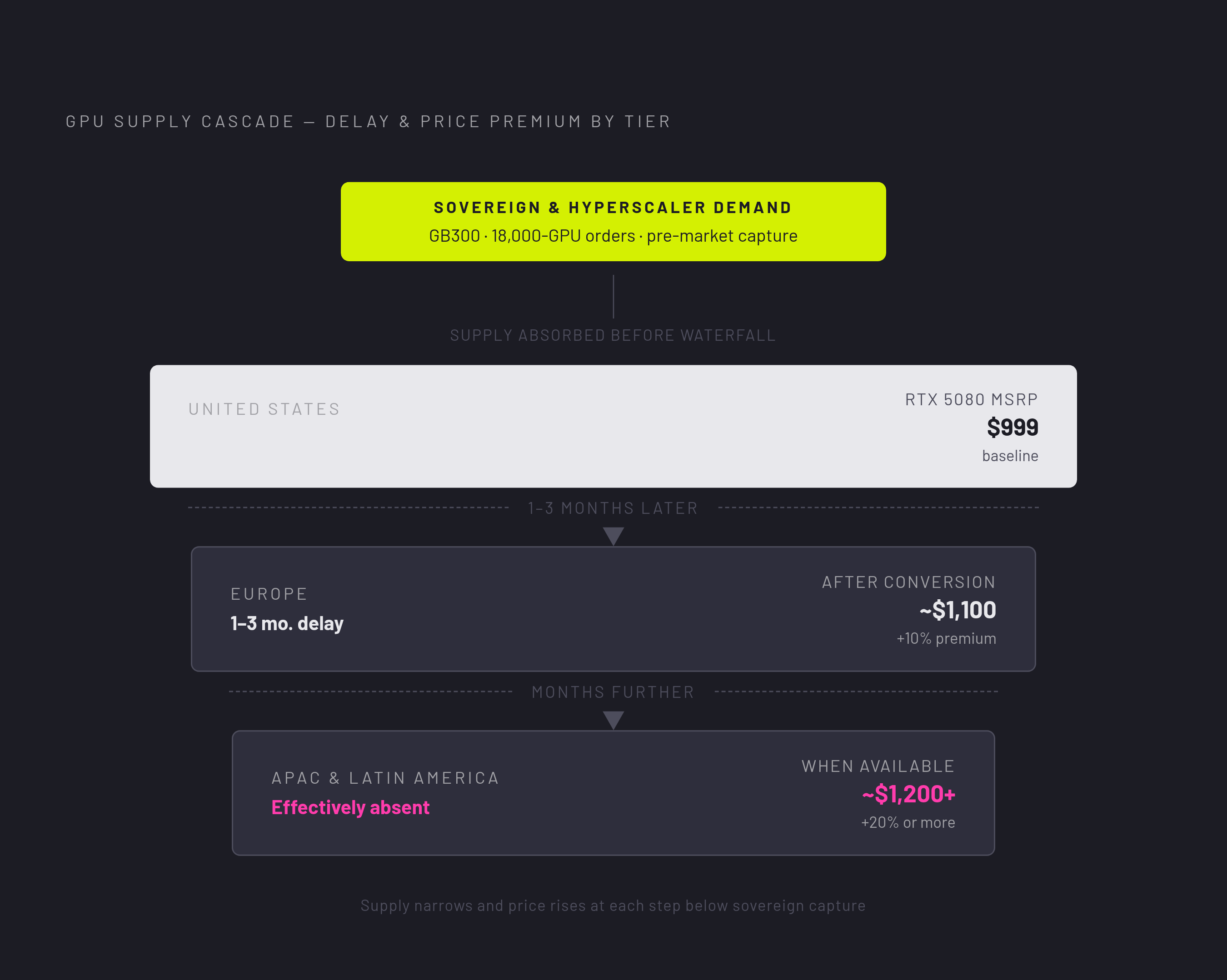
New GPU generations reach US retail first. European availability typically follows one to three months later, and APAC and Latin America trail further still. This sequencing isn't incidental to how manufacturers and board partners plan a launch: it reflects where hyperscalers and add-in-board partners concentrate their launch-day inventory, and the United States sits at the top of that concentration every time.
The same logic governs cloud GPU allocation as consumer retail. US-East gets priority for new hardware because the majority of enterprise production workloads run there, and the capacity planning that follows enterprise demand shapes consumer retail distribution the same way. Industry coverage of where GPU capacity actually exists in 2026 confirms the sequencing directly: new GPU generations reach US providers first, with European availability following one to three months later as a documented, recurring pattern rather than a one-off anomaly tied to a single launch.
Two developments sharpened this asymmetry heading into 2026. The HBM memory crisis squeezed overall supply across the industry, reducing the total pool of chips available to distribute. Sovereign GPU demand, a newer and more durable pressure, redirected hardware that might otherwise have reached retail shelves or secondary markets toward state-level buyers instead. Both forces push in the same direction: less hardware, concentrated further toward the top of the waterfall, leaving less to trickle down to the regions that were already waiting longest.
What the RTX 50-Series Launch Revealed About Geographic Access
The RTX 50-series launch turned the allocation waterfall from a theoretical sequencing into something builders could watch happen in real time. The same GPU, released at the same moment, produced a completely different experience depending on where the buyer lived, and the UK-versus-US contrast in September 2026 is the clearest evidence that this asymmetry is not a one-time launch-week quirk but an ongoing structural condition. Stock inverted between the two markets that month, with the country that is supposed to sit atop the waterfall failing to reliably hold the advantage, underscoring just how volatile regional access can be even within a single product cycle.
The QuakeCon moment makes the distortion visible in its starkest form. Nvidia sold RTX 50-series Founders Edition GPUs at original launch MSRP at its booth at QuakeCon, held August 6 through 9, 2026, at the Gaylord Texan Resort in Grapevine, Texas, framing the sale as "Verified Priority Access IRL" and presenting it as a promotional draw for attendees. More than a year after the RTX 50-series launched, buying a card at its original list price had become a convention attraction rather than an ordinary retail transaction, which says as much about the state of global availability as any pricing chart could.
Regional Price Divergence and the Access Gap
Finding stock and finding fair pricing are two separate problems. A builder who locates a card still has to contend with a market where street prices bear little relationship to the launch MSRP that shaped the original purchase plan. As of August 2026, current-generation GPUs sold for an average well above launch MSRP across all nine tracked current-generation cards, a baseline that holds globally before any region-specific premium gets layered on top.
The regional layering is where the real cost becomes visible. The RTX 5090's US median price climbed well above its launch MSRP by August 2026, and South Korea's street price ran higher still. In Europe, the RTX 5080 averaged meaningfully above the US equivalent once you convert at prevailing exchange rates. Some of that European premium is structural rather than opportunistic: VAT and import duties create a price floor in European and other markets that simply does not exist in the US baseline, so even a listing priced fairly by local standards carries a built-in markup over US MSRP before any scarcity premium is added.
The fallback that builders have traditionally used to dodge launch-day markups, buying used, has stopped working as a workaround. As of July 2026, the median used GPU price averaged above new retail across all 21 tracked models. A used card, historically the discount option, now frequently costs more than buying new, which closes off the one channel that used to offer price-conscious builders an escape from a strained launch market.
APAC and Latin America's More Severe Version of the Structural Problem
Europe's position in the allocation waterfall is frustrating, but it is the milder end of a spectrum that gets considerably harsher further down. APAC and Latin American builders encounter the waterfall's sharpest edge: a delay in getting access, and in some cases an effectively absent regional supply channel for the newest hardware. For APAC consumer builders, street prices on top-end cards exceed US pricing by a meaningful margin, so the region pays a premium on top of a delay.
Latin America shows the widest gap between announced infrastructure investment and what a builder can actually rent this week. Coverage of where GPU capacity actually exists in 2026 notes that Microsoft committed $2.7 billion to Brazilian cloud and AI infrastructure in 2026, and that AWS committed to a major site in Querétaro, Mexico. Neither commitment changes what's available to rent in the region today: the headline investment figures represent real capital and power contracts, not GPU inventory sitting ready behind an API key right now.
Canada illustrates the same gap in a market builders might otherwise assume sits close to US parity. Canada's publicly funded sovereign compute capacity is expected to deliver significant service within 18 months of signing contribution agreements, which puts the earliest realistic capacity at late 2027 or 2028. A published roadmap and a bookable GPU are not the same thing, and the lag between the two is measured in years even in a market with substantial public investment behind it.
Sovereign GPU Demand and Regional Allocation
A new category of buyer has entered the top of the GPU supply chain, and it changes the planning horizon, not just the current numbers. National governments now compete directly with consumer retail and commercial cloud providers for the same constrained hardware pool, a permanent reallocation of supply away from consumer and commercial channels in the affected geographies rather than a temporary demand spike that eases once a backlog clears.
Saudi Arabia's HUMAIN placed the largest sovereign GB300 order of 2026, an 18,000-GPU Nvidia GB300 supercomputer. Coverage of where GPU capacity actually exists in 2026 is explicit that this is sovereign-use hardware under Saudi state control, not a commercial cloud product, and it is not available to any outside buyer at any price. An order of that scale can look, from the outside, like regional GPU abundance arriving in the Gulf. The effect on consumer markets in the same region runs in the opposite direction, because hardware absorbed at the sovereign level does not flow down into retail or commercial cloud pools nearby.
Nature Computational Science published a June 2026 editorial that names the concentration of GPU capacity in a small number of countries a structural constraint on scientific participation itself. Epoch AI data cited in that context shows the United States hosts the majority of high-performance GPU cluster capacity globally, with China a distant second, and research institutions in the Global South operate on computational budgets that are orders of magnitude smaller than those available in high-income countries. Researchers have described this gap as a structural divide in global computing access, and what a builder experiences as a pricing inconvenience is, at the research infrastructure level, the same underlying concentration problem playing out with far higher stakes.
What Builders Outside the US Can Realistically Do
Understanding the allocation waterfall won't make it disappear, but it does change the decisions available to a builder: timing, card selection, channel choice, and expectation-setting are all adjustable even while the underlying supply structure stays fixed.
On card selection, AMD's RDNA 4 line has held pricing better than Nvidia's Blackwell cards through the memory crisis. The Radeon RX 9070 XT stands out as the strongest enthusiast-value counterweight for non-US builders as of mid-2026, though software remains a differentiator that still favors Nvidia for certain workloads. The prevailing advice among hardware journalists is to pivot toward AMD or the Intel Arc B580 at regional price points rather than wait for Blackwell allocation to normalize in a given market.
On timing, GPU prices trended slightly downward during the first half of 2026 for some models, but the memory shortage pushed prices back upward starting in July. Builders who waited for a further dip after that brief window of normalization missed it entirely, and the broader supply picture is not expected to normalize until 2027 to 2028. Waiting indefinitely for a better moment has a real cost attached to it in this market.
On channel choice, the UK-versus-US stock inversion in September 2026 shows that secondary markets and non-primary retailers sometimes hold stock that primary US retail doesn't. The Overclockers UK case is instructive here: builders in non-US markets do better monitoring regional specialist retailers directly rather than treating US retail availability as a stand-in for their own market's conditions.
On expectation-setting, coverage of the 2026 GPU shortage draws a useful distinction between hardware scarcity and cloud capacity scarcity, which are not the same problem. If a hyperscaler shows no on-demand GPU capacity, it is usually prioritizing reserved enterprise commitments over running out of physical hardware. For cloud-reliant builders, allocation policy is the variable to watch, not raw supply.
Planning the physical build before committing budget matters more in a constrained market than in a normal one. Knowing exactly which GPU slot a case, cooling setup, and power delivery system are built around, before prices shift again, lets a builder move the moment stock appears rather than restarting a compatibility check under time pressure. A planning tool like BuildCores, built around real-time compatibility checking and multi-retailer price comparison, closes that specific gap between the planning phase and the purchase moment, which is exactly where constrained markets punish hesitation.
Setting realistic expectations: what the timeline to normalization looks like
The forces driving regional GPU asymmetry, HBM fab capacity, CoWoS packaging constraints, sovereign demand, and the hyperscaler reservation model, won't resolve on the timescale of a single product cycle. Coverage of the 2026 GPU shortage puts the CoWoS supply-demand gap narrowing from roughly a fifth to a tenth by the end of 2026, with meaningful new HBM fab capacity not coming online until 2027 to 2028. Supply normalization sits on a multi-year horizon, not a quarterly one.
Canada's publicly funded sovereign compute capacity points to late 2027 or 2028 for earliest realistic delivery. European national AI factory programs in Germany and France are building out their own capacity, though most EU AI teams still route through US infrastructure in practice today.
Builders in non-US markets should treat the current allocation structure as the baseline through at least mid-2027 and make card and timing decisions on that basis. Any regional stock improvement that arrives before then should be acted on quickly, but read as an opportunity rather than a sign that the underlying structure has resolved. The launch-day press release describes an ideal; the waterfall describes what actually reaches a given market, and planning against the latter is what keeps a build on schedule.