ATX 3.0 and PCIe 5.0 Power Connector Adoption Challenges
Power spikes and poor contacts turn new connectors into heat risks despite design improvements.
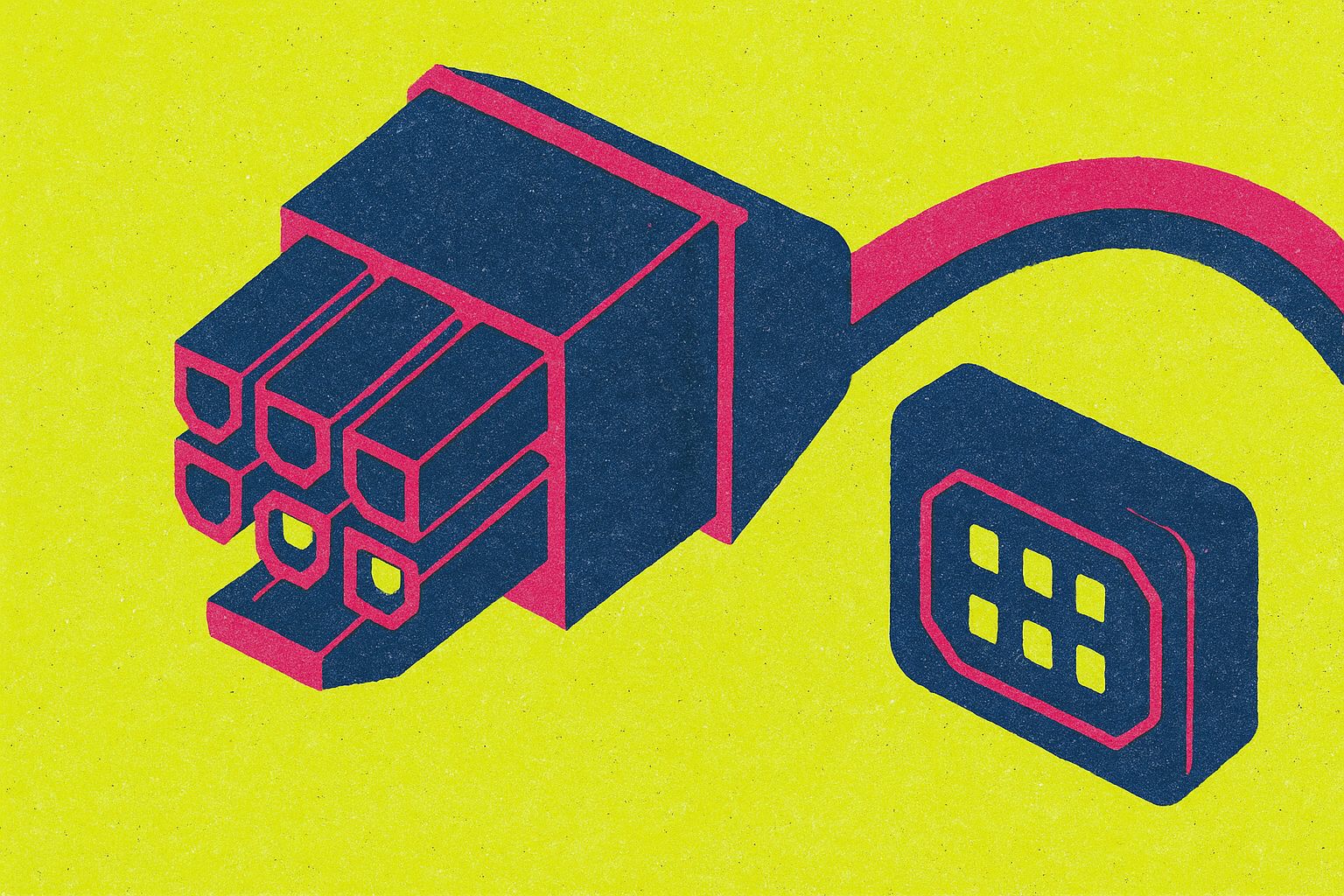
The shift to PCIe 5.0-era graphics cards broke the old assumption that a PSU's wattage rating was the only number that mattered. Legacy 6-pin and 8-pin connectors were built for 75W and 150W respectively, and running a flagship GPU off several daisy-chained 8-pin cables meant uneven loads spread across connectors never designed to work as a team. The deeper issue was the timing of power delivery, not raw capacity. Modern GPUs don't draw power in a smooth, predictable line. They spike in short, violent bursts as the chip boosts, and ATX 2.x never required a PSU to handle these "power excursions" as a formal spec item. That left plenty of units with wattage ratings that looked sufficient on paper but that tripped overcurrent protection the moment a GPU hit a boost cycle under load. For anyone running an older PSU through 8-pin adapters, the real capacity needed, once GPU draw, CPU draw, and excursion headroom were all stacked together, often ran well past what the original purchase had budgeted for. ATX 3.0 and its 12VHPWR connector were built to close that gap, consolidating power delivery into a single, higher-capacity connector with a spec that actually accounted for how these cards behave under load. That fix introduced a new problem almost immediately.
How the 12VHPWR connector's design caused its own melting failures
The melting incidents tied to 12VHPWR were not a string of unlucky coincidences. They trace back to a specific choice in how the connector handles current distribution. Starting with a recent Nvidia RTX generation, all the 12V pins on the connector are tied together internally on the GPU side. That means the card has no way to tell whether every pin is making solid contact. If several pins are seated poorly, the card may still try to pull its full current load through just one or two that are. Current concentrated through one or two contact points generates heat fast: partial insertion of an ATX 3.0 12VHPWR cable produced connector temperatures measured as high as 124°C on a misseated RTX 4090.
Nvidia investigated the RTX 4090 connector failures and attributed the cause to improper insertion by users, offering an expedited RMA process to affected owners. PCI-SIG, the body that maintains the PCIe and connector specifications, pushed back on that framing, stating that Nvidia and its partners remained responsible for designing, manufacturing, and testing their own products, including safety testing that should have accounted for the problem cases being reported. That exchange matters because it shows builders were left in the middle of an accountability gap between the company making the card and the body that wrote the spec the connector was built to.
Cable routing makes the risk worse in ways that are easy to miss during a build. Bending the cable sharply within a few centimeters of the connector housing can shift terminals out of alignment inside the shell, and tight horizontal bends in cramped cases can pull certain pins back just enough to shrink their contact area and raise resistance. Corsair, explaining the design behind its ThermalProtect cable, pointed to a related failure path: the connector can loosen gradually over time from cable tension and vibration, so a connector that seats correctly on build day can still develop resistance, and heat, months later with no obvious cause. On top of that, the connector has a hard mechanical limit. Many 12VHPWR cables are rated for only around 30 to 40 plug and unplug cycles before contact resistance builds up enough to become a real concern, which matters for anyone swapping GPUs more than occasionally.
What ATX 3.1 and the 12V-2×6 connector fixed
The 12V-2×6 connector, introduced alongside PCIe CEM 5.1 and PCIe ECN 6.0, redesigned the sockets on both the GPU and PSU sides so the sense pins only make contact once the power pins are fully seated, addressing the most common version of this failure directly. A partially inserted connector under the new design simply won't let the GPU boot, instead of letting the card try to draw current through incomplete contact the way the original 12VHPWR did. That is a meaningful mechanical correction to the exact failure mode that produced the RTX 4090 incidents.
It leaves heat buildup at the top of the power curve unaddressed. Melt incidents have continued to appear even on cards using the newer 12V-2×6 socket, because the connector's rated ceiling of 600W leaves very little thermal margin once a GPU's power draw gets close to that number. The RTX 5090 ships with a TGP of 575W, within 25W of the connector's rated continuous capacity, so even a cable seated perfectly and fully compliant with the new spec is still operating with thin margin for heat buildup at the contact points. Heat damage was reported on a Gigabyte AORUS Master ICE GeForce RTX 5090 running under a 500W power cap, which shows that dialing back power draw doesn't automatically remove connector risk once a card lives near the connector's ceiling to begin with. Corsair's response to that reality is the ThermalProtect cable, which uses a bimetallic thermal switch that physically opens and cuts current flow once the connector hits 65°C, acting before the heat can cause lasting damage. The mechanical lockout fixed the insertion failure. The physics of pushing nearly 600W through one connector did not go away with it.
The "ATX 3.0 Ready" label and the gap between certification and compliance
Beyond the hardware itself, there's a second barrier that has nothing to do with electrical physics and everything to do with loose language in the original ATX 3.0 specification. That looseness let manufacturers apply an "ATX 3.0 Ready" label to products that never had to clear the standard's toughest requirements. Igor'sLAB's analysis of the spec lays out the core issue: two of the connector's smart signal pins require an entirely new PSU design to support true smart communication, a capability that neither current PSUs nor current GPUs actually use. By that reading, a lot of what gets sold today as "PCIe 5.0 compatible" is older internal hardware wearing a new connector, not a PSU built around the full spec.
The certification path itself has a loophole built in. A vendor can skip the 12VHPWR connector entirely and still pursue ATX 3.0 certification, because doing so lets them avoid the most demanding connector-level tests altogether, and some manufacturers took that route simply to get product to market faster. The single hardest test to pass is the power excursion requirement, which forces a PSU to sustain roughly double its rated wattage for 100 microseconds, a transient spike far beyond anything the nameplate number suggests the unit needs to handle. Seasonic acknowledged in its own launch materials just how hard this test is to clear, noting that units which simply "slapped a 12VHPWR connector on the PSU housing" tended to fail it, because they were never built or tested with that transient in mind.
Builders on Tom's Hardware forums have documented PSUs sold under an "ATX 3.0 Ready" label that manufacturers later admitted was applied in error. The label on the box is not proof of anything on its own. Independently tested PSU tier lists, built from actual bench results rather than marketing copy, give a far more reliable read on whether a given unit clears the standard's harder requirements, and that distinction is worth checking before trusting a label at face value.
ATX 3.0 and 3.1 adoption barriers across flagship, mid-range, and budget builds
Whether ATX 3.1 adoption actually matters for a given build depends almost entirely on which GPU tier that build is aimed at. The connector's risks and the standard's benefits aren't spread evenly across the market, so the right decision looks different at each price point.
At the flagship tier, covering cards like the RTX 4090 and RTX 5090, the 12V-2×6 connector runs closest to its rated limit. The safety margin is thinnest there, and the cost of a connector failure is highest. ATX 3.1 compliance here isn't a box to check for marketing purposes. The mechanical lockout and the 200% transient tolerance are both doing real, load-bearing work at TGPs running from 450W to 575W, and skipping a compliant PSU at this tier means skipping the exact protections built for the exact power levels these cards draw.
At the budget tier, the picture has changed for the better. The Endorfy Vero L6 750W meets both ATX 3.1 and PCIe 5.1 spec, ships with a dedicated 12V-2×6 cable, and has enough headroom to power an Nvidia GeForce RTX 5070 alongside a mid-range CPU comfortably. That's a sign that entry-level ATX 3.1 hardware is now genuinely affordable at a low price. The price gap that used to make ATX 3.0 a hard sell at the lower end has largely closed, taking away the financial excuse for sticking with an adapter-based older PSU on a new build.
AMD users sit in a slightly different position for now. AMD's unreleased reference design for the Radeon RX 9070 XT uses traditional dual 8-pin sockets rather than the newer connector. AMD never shipped that reference card publicly, so every retail RX 9070 XT on shelves is an AIB partner design, but the reference approach gives most AMD builders a practical buffer against the exact failure modes described above, at least for now.
Where the standard is expanding: AMD's professional segment adoption
Connector reliability now extends beyond consumer gaming rigs. AMD's Instinct MI350P, its first 600W PCIe card, carries the 12V-2×6 connector into professional compute workloads alongside 144GB of memory. That card runs the connector exactly at its rated ceiling, in a setting where unplanned downtime costs far more than it would in a home gaming build.
The move into professional hardware points to where the pressure on this connector family is headed. As TGPs climb on both the consumer and the enterprise side, the 600W ceiling that felt like generous headroom when 12VHPWR first launched in 2022 is getting tested from multiple directions at once. It also undercuts the idea that melting incidents are mainly a story about careless users mishandling cables at home. Enterprise deployments follow strict cable management procedures as a matter of routine, and the same thermal physics apply to a data center rack as they do to a desktop tower. If a 600W-rated connector is already running near its ceiling in professional gear, that is a property of the connector itself at these power levels, not a fluke of consumer carelessness.
PSU checklist for late 2026 buyers
Between the gap separating certification labels from actual tested compliance, and the thermal risk that persists even on fully compliant hardware at high TGPs, picking a PSU in late 2026 takes more scrutiny than matching a wattage number to a badge on the box.
Default to ATX 3.1 for any new build rather than treating the older 12VHPWR-based ATX 3.0 generation as an acceptable substitute, since the mechanical lockout in the 12V-2×6 connector closes off the specific failure mode that caused the original RTX 4090 incidents. Confirm that a PSU actually includes a dedicated 12V-2×6 cable rather than an adapter bridging from older 8-pin outputs, since adapters reintroduce the uneven contact risk the new socket design was built to eliminate. Weigh the GPU tier honestly: a build around an RTX 4090 or RTX 5090 needs a PSU that's been independently tested against the power excursion requirement, while a mid-range build has more flexibility and, as the Endorfy Vero L6 750W shows, more affordable compliant options than existed before. Treat any "ATX 3.0 Ready" or "ATX 3.1 compliant" label as a starting point for research rather than a final answer, and check independently tested tier lists before trusting marketing copy on the box. For anyone running a card that draws power close to the connector's 600W ceiling, a cable with a built-in thermal safeguard, such as Corsair's ThermalProtect design with its 65°C cutoff switch, adds a layer of protection that the base spec alone doesn't provide. None of this makes the decision complicated so much as it makes clear that wattage was never the only number that counted, and in late 2026 it still isn't.