GPU Market Cycles and the Second-Hand Pricing Lag
Used GPU prices now track new-card premiums driven by AI memory demand.

The used GPU market in late 2026 is not offering the escape route from inflated new-card prices that it has provided in past cycles. The same force driving new-card prices up has become the floor under used prices too, which breaks the basic assumption builders have relied on for years: that a used card trails new pricing by a predictable discount.
A used card is supposed to cost meaningfully less than a new one. When new prices spike for a cycle, used prices are supposed to stay anchored to something closer to depreciated value, the price the card would fetch based on age and wear, not on what's happening three steps upstream in silicon supply. That's how the market behaved through prior shortages, including the mining-driven price run of past years. It is not how the market is behaving now. The RTX 3090, a card that launched in September 2020, has risen to an average of $1,343 across recent sold listings. Six years old, built on an architecture two generations behind current hardware, and selling for a price that would have read as a typo in any prior market condition. The cause is structural: it starts with a decision made far from the used-market listings themselves, in the memory supply chain that feeds every GPU built today, rather than with a shortage of buyers or a wave of irrational sellers holding out for unreasonable money.
AI-Driven Memory Reallocation as the Dominant Cost Input for Consumer GPUs
The GPU price environment of 2026 doesn't resemble a supply crunch in the traditional sense, where a fab goes offline or a part gets recalled. It is the downstream result of memory manufacturers routing their output toward the customers who pay the most for it, and those customers are no longer gamers or even GPU makers writ large. They're the buyers of the memory used in AI data center hardware, and they're paying prices consumer graphics cards were never built to compete with.
Nvidia's own finance leadership has described the shift in blunt terms. CFO Colette Kress, on a recent earnings call, said the company is "experiencing extreme pricing conditions in memory," adding that "the magnitude of the price increase has exceeded our prior expectations and are headed even higher into next year," a statement from the company best positioned to see the entire memory market, showing the increase is accelerating.
The practical effect is visible in what new cards actually sell for. The Tom's Hardware GPU price index, updated September 3, 2026, shows nearly every current-generation card selling well above its launch MSRP, with street prices running at multiples of official list on flagship models. The Radeon RX 9070 GRE stands out as an exception, selling at or below its MSRP, but it's the exception that proves how unusual the rest of the market has become. For nearly every other card on the shelf, the MSRP printed at launch has become a historical footnote that no one actually pays. New tariff policies on electronics imports added a second layer of cost on top of the memory shock, and board partners have passed both costs through to buyers at the same time, which is part of why the increases have landed as hard as they have.
The Used Market's Floor, Now Set by New-Card Prices
A used GPU's price has always been anchored to the price of the new card it replaces. That relationship hasn't changed. What's changed is the price it's anchored to. When the new card is trading at multiples of its MSRP, the used card's floor rises right along with it, even though nothing about the actual condition, age, or performance of the used card has changed.
The new-card shelf sets every used price beneath it. That's the direct framing to draw from the current used-market data, and it is the single idea the rest of this piece depends on. Once a buyer accepts it, the RTX 3090's $1,343 average sale price stops looking irrational and starts looking like simple arithmetic. The card carries 24GB of GDDR6X memory, bought and soldered onto its board back in 2020, years before memory manufacturers redirected their production toward AI customers. A used GPU is, in effect, the only graphics card on the market whose memory was purchased at pre-shortage prices. That makes a six-year-old card a kind of arbitrage play on the current memory shortage: a buyer isn't just getting 24GB of VRAM, they're getting 24GB of VRAM that was manufactured before the price of that VRAM tripled. Sellers have figured this out, and the listings reflect it. A card that should be deep into its depreciation curve by any normal measure is instead holding value because the thing that makes it valuable, its memory capacity, now costs far more to replicate on a new board than it did when the 3090 was built.
How the lag manifests differently across the used-market tier structure
The clearest illustration of how this plays out sits in a direct comparison: a used RTX 3060 with 12GB of VRAM commands a higher price than a used RTX 3060 Ti with 8GB, despite the Ti being the faster card in nearly every game benchmark, the market stating in plain numbers that memory capacity now matters more to buyers than core processing performance, at least at this tier.
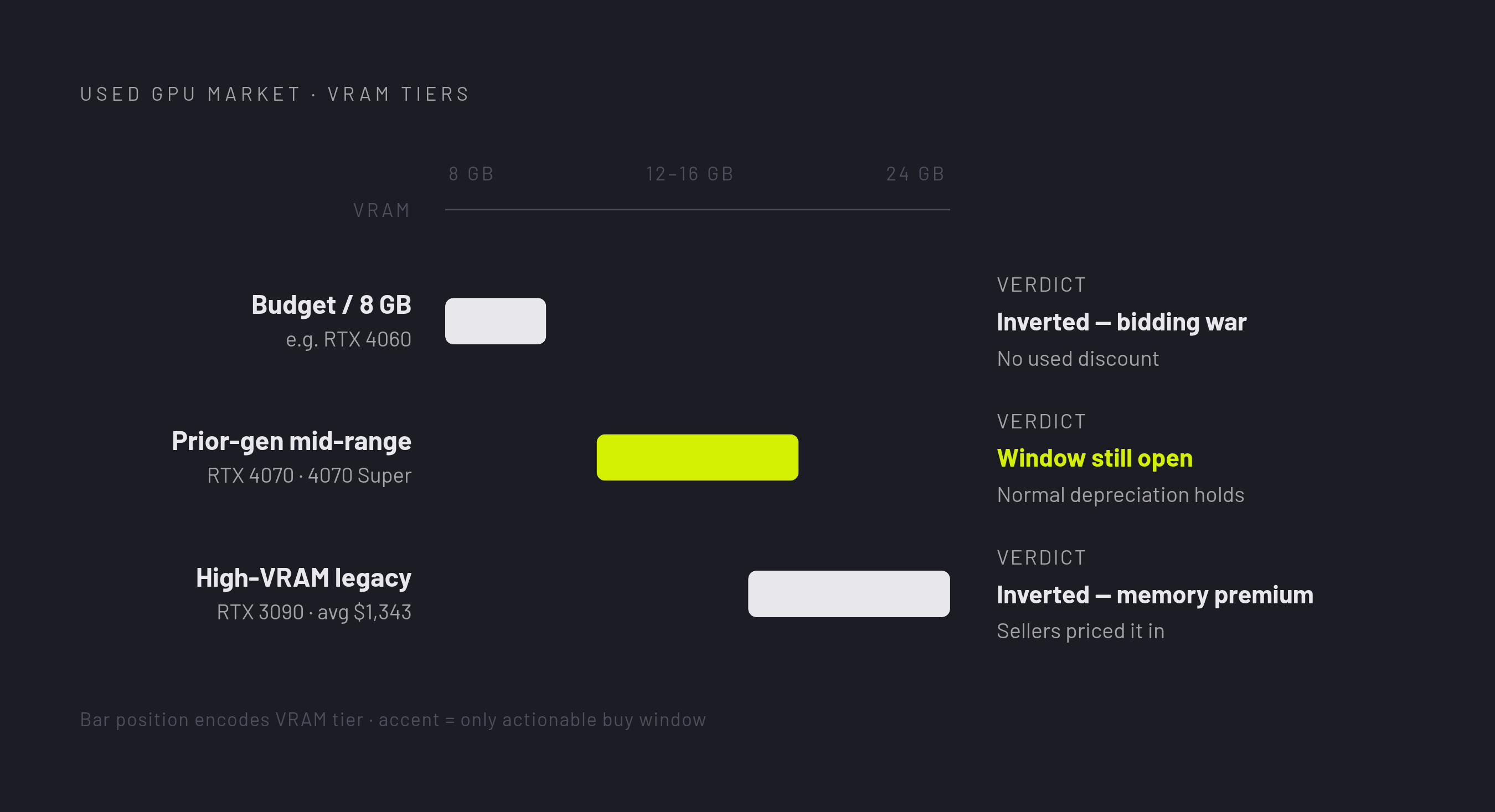
The used market isn't distorted uniformly. It splits along a VRAM axis, and three distinct things are happening at once depending on where a card sits on that axis. Budget cards are being pushed upward by buyers who got priced out of new RTX 50-series stock and are now bidding against each other for last-generation alternatives, which compresses the discount that would normally exist at the entry level. Prior-generation mid-range cards come closest to behaving the way used hardware traditionally has. Used RTX 4070 inventory is discounted below its original MSRP, the most conventional depreciation pattern visible anywhere in the current market, mostly because the card launched before the acute phase of the shortage repriced everything above it. The RTX 4070 Super tells a different story: it's trading at or above its own launch MSRP, even used, which shows how uneven the repricing has been even within a single product generation.
High-VRAM cards, meanwhile, are appreciating for reasons that have little to do with gaming performance. Professional and workstation cards pulled from corporate refresh cycles often carry more VRAM per dollar than any current gaming card on the market, even though they run slower in actual games. For buyers doing AI or rendering work, where memory capacity determines what workloads will fit at all, that tradeoff is a legitimate one. For a gamer evaluating the same card, it's close to irrelevant. The new-card market shows the same VRAM-over-performance logic at work: the RTX 5060 Ti in its 8GB configuration sells near its original launch price, while the 16GB version of the same card commands a premium far larger than the cost of the extra memory itself. Nvidia priced the gap between those two configurations modestly. The market is charging several times that amount for it, and that premium has carried straight through into the used tier below it.
The 16GB VRAM Crossover on Steam and the Used Tier Structure
A widely cited hardware survey logged its first-ever crossover moment in 2026: for the first time since the survey began tracking the data, 16GB GPUs account for a larger share of surveyed systems than 8GB GPUs. That's a population-level shift, not a niche enthusiast trend, and it gives real support to the VRAM pricing signal already visible in the used market.
The obvious objection deserves a fair hearing. Critics point out that high-end adopters, not mass-market necessity, are likely driving a meaningful share of that crossover, and that 8GB cards remain perfectly playable at 1080p resolution today. Both of those points hold up. An 8GB card run at 1080p with reasonable settings still performs fine in most current titles. But that's a description of today's workload, not a safe assumption for a purchase meant to last multiple years. A used card bought now needs to survive for several years, and the Steam data says the floor is moving upward under it while it sits in someone's case.
The practical implication for a builder is straightforward: treat 12 to 16GB as the minimum for any new GPU purchase in 2026. That standard applies just as much to used cards as new ones. An 8GB used card isn't simply a current-generation compromise, accepted in exchange for a lower price today. It carries real longevity risk even at the lower price points where 8GB cards tend to sit, because the games and applications that will matter in two years are being built against a VRAM baseline the 8GB generation wasn't designed to meet. Seen through that lens, the premium the used market charges for 12 to 16GB cards reads differently than it did at first glance. The premium isn't purely a panic premium disconnected from reality: it's a correct, if blunt, pricing of a functional threshold that the Steam data confirms is already shifting under the entire market. A builder working through a parts configurator and checking VRAM against an intended resolution and workload should weigh that shift directly rather than pricing a used card against last year's performance benchmarks alone.
The Lag as a Decision Window
The lag between a change in new-card prices and the used market catching up to it has narrowed considerably compared to past cycles, and in 2026 it only creates genuine value in one specific part of the market: prior-generation mid-range cards. It does not create value in current-generation used inventory, and it has already closed, or inverted, in high-VRAM legacy cards.
The window that remains open sits with used RTX 40-series mid-range cards. These depreciated on something close to a normal curve before the memory shortage repriced everything above them, and while they've already been bid up by displaced buyers, that bidding hasn't fully erased the gap. Used RTX 4070 and RTX 4070 Super inventory comes closer to historical depreciation behavior than anything else currently for sale, which makes this tier the most defensible place to apply the classic "buy used and save" logic in the current market.
The window that has inverted sits with cards like the RTX 3090. High-VRAM legacy cards have appreciated well past the point where buying used still confers an advantage, because sellers have already priced in the memory shortage premium these cards now carry. A buyer arriving late to this trade is paying full price for an insight the market absorbed months ago.
The strongest case against a simple "wait for used to come down" strategy is that used sellers now have access to the same real-time pricing data buyers do. The information asymmetry that used to reward a patient buyer, the gap between what a seller knew their inventory was worth and what a buyer could find out by shopping around, has largely closed under transparent, instantly searchable marketplace pricing. A tool that puts new and used prices for the same part side by side in one view, the kind built into modern parts configurators, makes that spread visible immediately, and that transparency has shortened the lag industry-wide, concentrating its remaining value narrowly in one tier of the market.
Why no near-term catalyst will reset this market
Nothing on the near-term horizon points toward memory manufacturers redirecting meaningful production capacity back toward consumer GPUs. The economics explain why: AI infrastructure buyers are paying prices for memory that consumer graphics cards cannot match, and that gap in willingness to pay is the reason the shortage reached consumer GPUs. There's no scheduled fab expansion, no policy change, and no demand collapse on the AI side serving as a credible trigger that would reverse the allocation logic described earlier in this piece.
For a builder deciding when to buy, that absence of a reset catalyst should outweigh any single price point in the decision. Waiting for new-card prices to fall back toward MSRP assumes a correction that nothing in the current supply chain suggests is coming. Waiting for used prices to decouple from new prices assumes the same thing, since the used floor is set by the new-card shelf above it. The realistic planning assumption is that current pricing, across both new and used tiers, holds for the foreseeable future. Within that reality, the one actionable move is tier selection: prior-generation mid-range cards still offer a real, if narrow, advantage over buying new, while current-generation inventory and appreciated high-VRAM legacy cards no longer do. A build timed around that distinction, rather than around a hoped-for market correction, is the only version of this decision grounded in what the data actually shows.