AIB Partner Pricing Strategies and the GPU MSRP Fiction
Nvidia's rising GPU kit costs push retail prices far above official MSRPs.

MSRP for a GPU is a number Nvidia or AMD prints at launch and mostly walks away from. It was never a promise about what you'd pay at checkout, and in 2026 the gap between that printed number and the shelf price has turned into a canyon.
What MSRP was never designed to do
MSRP is set by the chip designer, Nvidia or AMD, not by the company that actually manufactures and sells the card sitting on a shelf or in an online cart. Asus, MSI, Gigabyte, Sapphire, none of them set that number. They just get handed it.
Its purpose was always narrow: give retailers a reference point to build a promotion around, and give tech press a clean figure to put in a launch headline. It was never a commitment that anyone, anywhere, would sell the card at that price on the day it shipped, let alone six months later.
Look at where things stand now. The RTX 5090 still formally carries its $1,999 MSRP from its January 2025 launch. The RTX 5070 still carries $549. Neither number has changed on paper, not officially, not in any press release. What's changed is upstream of the MSRP entirely: the price Nvidia charges its board partners for the GPU-plus-memory kit that becomes the actual card. That number moves. The MSRP doesn't. And that disconnect is the whole story.
How the kit-price mechanism turns a chip maker's cost into your shelf price
AIBs don't buy a bare GPU chip and go shop for their own memory, unlike PC builders sourcing parts on the open market. Nvidia and AMD supply the GPU and the VRAM together, as a bundled kit, at a price the chip designer sets unilaterally.
That bundling means an AIB partner's card pricing rises or falls directly with Nvidia's kit price, with no way to offset it through cheaper sourcing. An AIB partner can't go find cheaper GDDR modules from a different supplier or negotiate VRAM cost independently of the chip. The kit price is the kit price, full stop. So when Nvidia raises what it charges for that kit, an AIB has exactly one place for that cost to go: retail. Nothing gets absorbed, because there's no margin sitting there to absorb it with. The AIB adds its own margin on top, covering PCB manufacturing, the cooler, the box, the warranty support, and passes the whole stack downstream.
The scale of the recent increase is not subtle. Nvidia notified partners of per-card kit price hikes of $90 on 8GB cards, $130 on 12GB cards, and $175 on 16GB cards, on top of separate, unrelated cost increases already hitting PCB manufacturing and cooling components. Those are two different cost pressures landing on the same card at the same time.
The memory shortage that made kit prices uncontrollable
None of this happens without a memory market that's been quietly reordering itself for years. Samsung, SK Hynix, and Micron make virtually all the GDDR and DRAM in the world, and all three have shifted capacity toward HBM and server DRAM built for AI accelerators, where margins run far ahead of anything gaming GDDR ever paid.
AI data centers are forecast to absorb as much as 70% of global memory output in 2026, a dramatic increase from earlier in the decade. That's not a gradual drift; it's a fundamental reallocation of where the world's memory supply goes, and gaming GPUs are competing for what's left over.
The trigger wasn't gradual either. AIBs had locked in memory procurement under fixed contracts running through 2025. Those contracts expired heading into 2026, and the moment they did, spot pricing hit the bill of materials directly, with no buffer left. GDDR6 spot prices roughly tripled in the aftermath, moving from around $2.50 to a price point well beyond triple that, depending on the batch and timing. A board partner that had been planning its 2026 lineup around 2025 contract pricing woke up to a completely different input cost.
Three rounds of Nvidia kit-price hikes in 2026
Nvidia didn't raise kit prices once and stop. It raised them three separate times across 2026, and each round stacked on top of the last rather than replacing it.
The first round, reported in January, ran 10% to 15%. The second, arriving mid-year and concentrated mostly on the RTX 5090, was narrower in which cards it touched but still meaningful in raw dollars, landing on a base that was already elevated from round one. The third round, reported after mid-year, hit 20% to 30%. Compounding across three rounds on an already-tight memory market is how a card with a $1,999 MSRP ends up costing more than double that at retail within a year of launch.
What each GPU tier costs in 2026 versus what Nvidia and AMD advertised
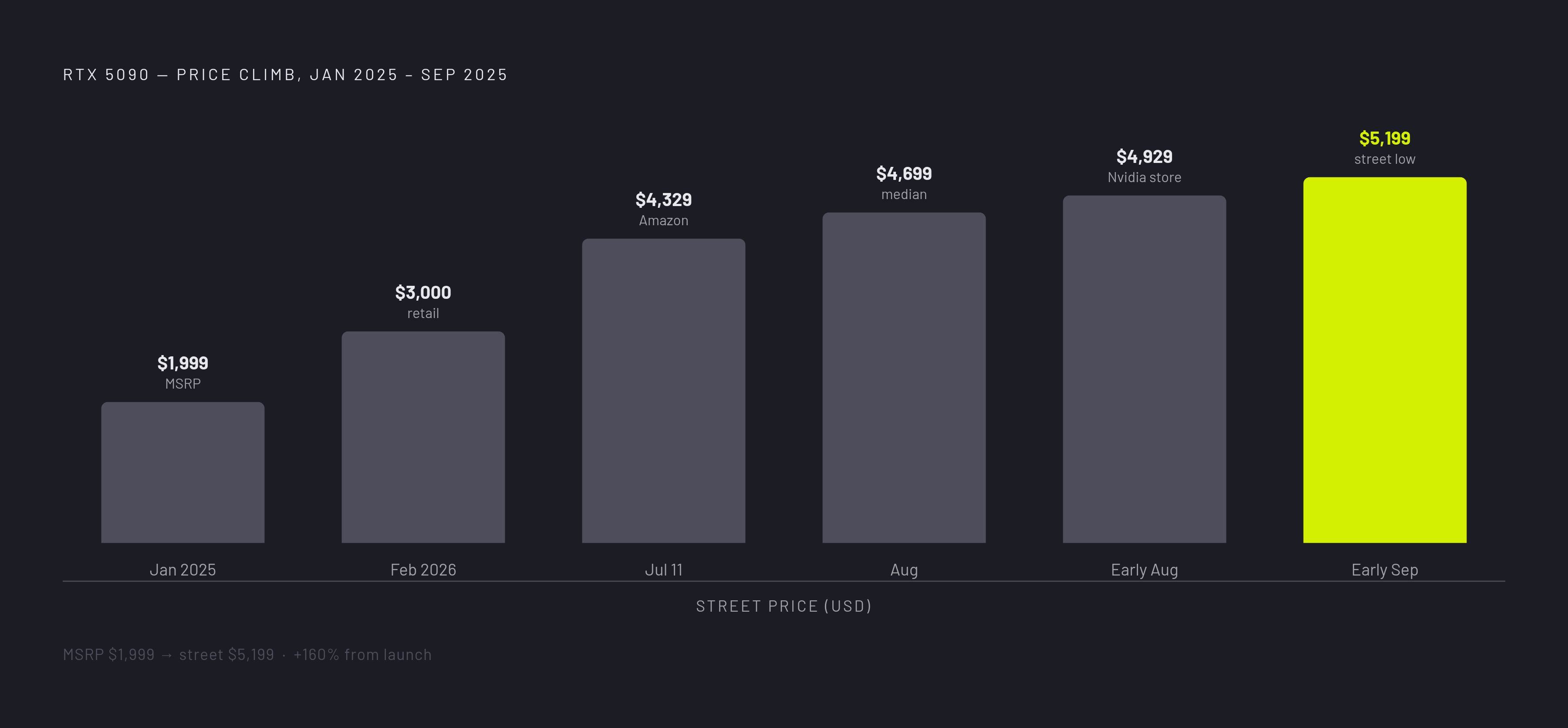
The RTX 5090 is the clearest case. It crossed $3,000 at retail by February 2026, months before Nvidia had even issued its own AIB price notices for the year, which tells you the street was already pricing in scarcity ahead of the formal kit increases. By July 11, Amazon retail pricing had reached approximately $4,329, with premium AIB listings running past $5,000. August's median price landed at $4,699.99, and the best available street price by early September, the lowest price findable online, was $5,199.
Europe tells the same story with different currency signs. The Asus ROG Astral OC was listed around 4,578 euros on Amazon. The ProArt model ranged 4,100 to 4,500 euros against its own 3,499 euro MSRP. Anniversary-edition ROG Matrix Platinum units exceeded 6,500 euros at retailer LDLC. And in one of the more telling data points of the year, Nvidia's own website listed the ROG Astral RTX 5090 at $4,929.99 in early August, up roughly $500, an 11.28% jump, from the prior listed price of $4,429.99. That's Nvidia's own storefront, not a scalper, not a reseller, confirming the new price floor.
The RTX 5080, with its $999 MSRP, isn't spared either. Most new 16GB GDDR7 models now sit 45% or more above that number. The Asus TUF RTX 5080 climbed from $1,199 to $1,595 by July 2026, a 33% jump on its own.
The RTX 5070 Ti, MSRP $749, has it worse, with the Gaming Trio OC model now running roughly 76% above its official sticker.
And the RTX 5070, the card Nvidia advertised at $549, is the tier where the gap looks most absurd relative to the number printed at launch. Expect to pay around $850 for any AIB-designed card in that lineup now, a climb of roughly 67% over its own late-2025 street price. This is the card that was supposed to be the affordable entry point into the RTX 50 generation.
How AIB brands respond to the same upstream cost: tiering, premiums, and what the branding buys
Every AIB using the same GPU silicon starts from the identical kit-cost floor. Differentiation, and the price spread you see in stores, happens entirely above that floor, in cooler design, PCB build quality, acoustics, and brand positioning.
Asus runs the clearest multi-tier strategy in the market and commands the highest premium for it. ROG, TUF, and ProArt each target a different buyer: ROG for enthusiast flagship builds, TUF for durability-focused mid-range, ProArt for creators who care about acoustics and thermal consistency over flashy lighting. In May 2026, Asus introduced a ProArt RTX 5090 with 32GB of GDDR7 and 3,352 AI TOPS, calling it the company's first 2.5-slot RTX 5090 design and claiming an 11% improvement in cooling efficiency over prior layouts. Asus justifies a 15% to 20% premium over comparable AIB cards from other brands based on that kind of engineering differentiation. The ROG Astral RTX 5090 listed at $4,929.99 on Nvidia's own site is proof of both things happening in the same product: the MSRP fiction sitting untouched on paper, and the tier premium stacked visibly on top of the inflated kit cost.
MSI hasn't been coy about any of this. The company has signaled that prices will rise across its 2026 gaming hardware lineup, with multiple GPU tiers affected. A board partner stating this openly rather than murmuring it to reviewers turns it into disclosed commercial reality.
Smaller AIBs are the ones absorbing the worst of the squeeze. They carry less negotiating leverage and less budget cushion than Asus or MSI, and they risk geth priced out entirely if larger partners lock up available inventory through volume deals. The practical consequence for a builder is a narrower set of choices at the lower end of the AIB spectrum, because the partners who used to serve that tier may not be able to compete for allocation anymore even though demand for budget-tier cards hasn't disappeared.
What this means for planning a build right now
Planning a build around the printed MSRP in 2026 means planning around a number that has had no functional relationship to shelf price since the kit-cost increases started compounding. The $549 RTX 5070 and the $1,999 RTX 5090 are marketing artifacts at this point, not budgeting tools.
The realistic move is to price a build off current street listings, not launch-day press releases, and to treat every AIB premium as a separate, deliberate decision rather than noise on top of a stable base price. A ROG or ProArt premium buys documented engineering, better cooling, tighter acoustics. That's a real trade a builder can evaluate. What can't be evaluated, because it isn't visible on any spec sheet, is how much of the sticker price in front of a buyer is memory-market scarcity passed through three rounds of kit hikes, compounding quietly since January. Whatever number is on the box, the honest starting assumption for 2026 is that it was never the price. It's a historical artifact from a launch that happened before the memory market broke.
Sources
- Absurd GPU Pricing Update: Mid-2026 Edition | TechSpot
- Board Channels: AMD and NVIDIA GPU price hikes may reach AIB cards in Jan-Feb 2026 - VideoCardz.com
- NVIDIA AIB Partners Reportedly Hit with Significant Price Hikes for GDDR6 and GDDR7 Memory Kits Needed for RTX GPUs
- Oh goodie, apparently Nvidia is raising more prices for its AIB partners
- NVIDIA Hits AIB Partners With Second 2026 GPU Kit Price Hike, GDDR6 Cards Now Hit Too - Shane the Gamer
- AMD and NVIDIA graphics cards will be more expensive in early 2026 because of DRAM crisis
- techtimes.com