How Manufacturers Use Reference Designs to Control Ecosystem Economics
Reference designs let chipmakers set costs and limit upgrade paths across their entire ecosystems.

GPU and platform reference designs are economic instruments as well as engineering templates. They set costs, which components can be used, and how far a system can be upgraded before a builder compares finished products. Understanding that upstream control explains both the prices on the shelf and the choices available when configuring a system.
Why GPU manufacturers sell kits, not chips
A builder buying a card from ASUS or MSI is choosing a finished product whose core cost structure was largely set before either company designed it. NVIDIA and AMD have traditionally supplied add-in board (AIB) partners with kits containing a GPU die and GDDR memory chips. The partner solders those parts onto its own PCB, but the memory procurement decision has already been made. With these kits, the partner cannot buy cheaper memory on its own to lower the card’s starting cost.
The reference board is therefore more than an engineering shortcut. The bill of materials is already set for every finished card built around the kit. NVIDIA has reportedly shifted to supplying bare dies only, leaving AIBs to source memory themselves, so bundling should not be treated as universal. Where the bundle applies, however, the vendor controls both the processor and a major part of the cost structure surrounding it.
How the kit price becomes the shelf price builders see
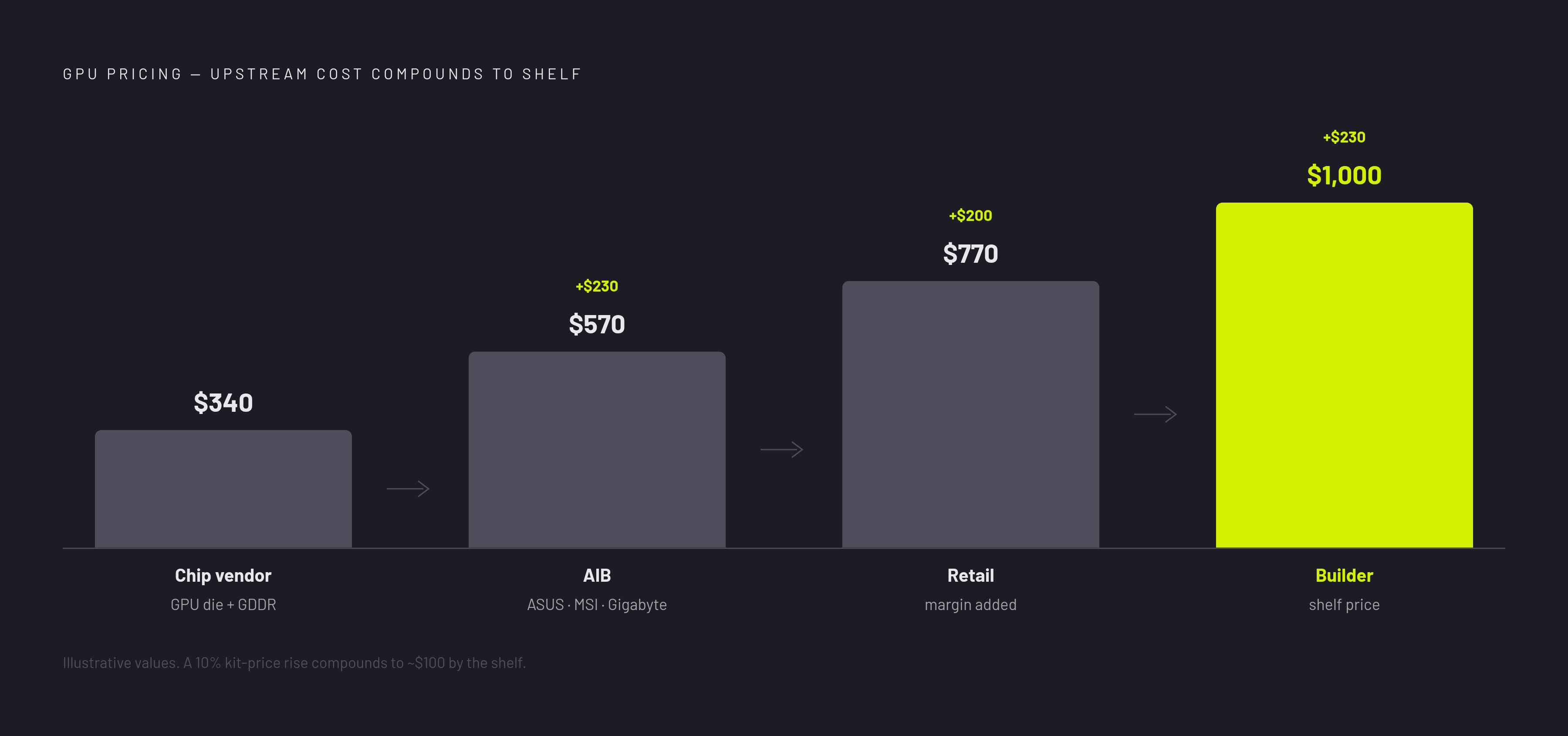
That starting cost becomes the base for a chain of pricing decisions. The chip vendor sets the kit price, the AIB calculates its costs and margin, and the retail layer adds its own margin before the card reaches the shelf. When each layer applies a margin to the cost it receives, a modest upstream increase can become a larger absolute dollar increase downstream. The builder sees only the result of those decisions.
ASUS, MSI, Gigabyte, and Zotac each decide independently how much of an increase to absorb and how much to pass on. Because the kit represents only part of the finished card’s cost, the retail increase can be smaller in relative terms than the kit increase. Yet that flexibility is bounded by margins already calculated against the reference floor. A cost change originating outside the gaming market can consequently arrive months later as a higher retail price, with little visible explanation of its origin.
What the reference floor means for the price spread across variants of the same chip
Across variants with the same die and VRAM, AIBs compete through cooling, PCB layers, power delivery, aesthetics, and brand premium. The common core establishes the floor, while those differences account for what sits above it. A meaningful gap between the cheapest in-stock model and the most expensive is therefore compatible with both cards using the same central components.
That spread is information rather than evidence that every premium is either justified or unearned. Assess what a particular variant changes and whether those changes matter in the intended system. Cooling and physical design belong in that assessment, as do the distinction between power delivery changes and cosmetic differentiation. BuildCores’ real-time price comparison across retailers and 3D visualization help make the price and visible design differences easier to compare. The evaluation still rests on separating the shared core from the features the AIB actually changed.
How AI infrastructure demand is now setting prices in the consumer GPU market
The larger change is that gaming demand no longer provides a sufficient explanation for the cost of that shared core. AI training and inference demand now drives VRAM pricing, with effects that reach consumer GDDR costs and bundled kits. Memory accounts for the majority of manufacturing expense on certain GPU models. That makes the memory component of the kit a major conduit for price pressure originating outside consumer graphics.
AMD’s mid-2026 kit price increases were described as a response to GDDR6 VRAM costs rising sharply because of demand from the AI sector. They were not presented as a response to gaming market conditions. A builder can therefore read gaming demand, new launches, and competitive pressure correctly and still miss the source of a price increase. Infrastructure buyers need to buy very different things, and their demand can be missed.
This changes the market model rather than merely adding another temporary disruption to it. Since roughly 2024, AI infrastructure economics have come to influence the inputs from which consumer products are built. When the parts come bundled, that effect reaches the AIB through the kit price before it reaches the builder through the retail price.
How kit decisions drive what VRAM tier ends up in builders' systems at scale
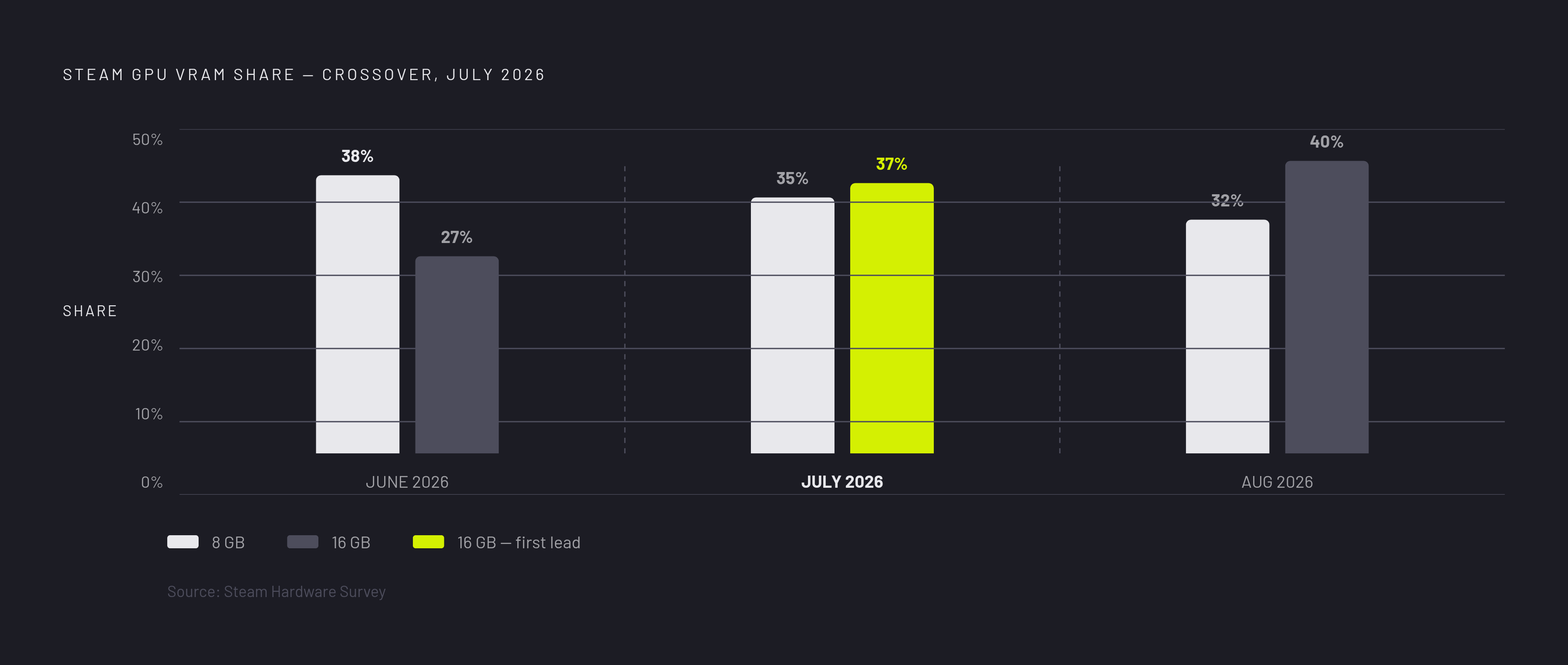
When manufacturers place a particular VRAM capacity into budget-tier kits, that capacity gradually spreads through the installed base. Steam’s July 2026 Hardware Survey showed that 16GB GPUs had overtaken 8GB cards for the first time. Steam’s August 2026 survey showed that lead widening.
The RX 9060 XT and RTX 5060 Ti illustrate the supply choices behind that transition, with both offering 8GB and 16GB variants. Their availability puts the higher memory tier within the choices offered to budget-tier buyers. The crossover is therefore not adequately explained as a spontaneous change in consumer preference. Buyers select from configurations manufacturers have already made possible at particular price points, and those configurations shape the eventual baseline.
Steam’s September 2026 survey showed a parallel shift in system memory, with 32GB RAM overtaking 16GB for the first time and reaching a plurality of surveyed systems. System RAM is distinct from GPU VRAM, but both trends show hardware standards propagating through real machines. BuildCores’ monthly hardware surveys also show what people in its community buy.
Platform socket strategy as the CPU-side version of the same mechanism
A GPU kit constrains the memory configuration available in a card, while a socket strategy determines how long a motherboard remains an upgrade target. In both cases, a manufacturer’s upstream decision limits what the builder can retain later. The expression differs, but the economic question is the same. How much of the initial investment survives the next hardware generation.
AMD’s May 31, 2026 Computex 2026 blog committed to AM5 support through 2029, spanning Zen 4, Zen 5, and Zen 6. That gives an AM5 owner from 2022 or 2023 a documented socket-level upgrade runway without replacing the motherboard. By contrast, a builder who selected Intel’s most recent consumer socket in 2025 is already at a platform dead end. Intel has acknowledged socket-lifespan shortcomings and signaled longer support for its newer socket, but without a comparable formal commitment.
Installed-base figures give context without making socket longevity the sole explanation for purchasing behavior. Steam’s April 2026 survey placed Intel at 54.81%, with 6-core chips the most common CPU configuration. Steam’s June 2026 survey showed that AMD had narrowed the gap to under 9 points. Promises of longer platform support affect that competition because they address the future cost of replacing a motherboard. A published support horizon is consequently part of platform value.
How reference design logic scales from consumer cards to data center infrastructure
At infrastructure scale, the reference design expands from a board or socket into an architecture for entire deployments. NVIDIA’s AI factory reference designs, rolled out from September–October 2025, combine digital twins with power, cooling, and controls architectures. Industrial partners include Siemens, Schneider Electric, and Trane. Their participation brings the surrounding infrastructure into deployments organized around NVIDIA’s architecture. The economic reach of the reference design extends well beyond the processor itself.
NVIDIA’s proprietary NVLink architecture ties interconnect, memory bandwidth, and the software stack together. Substituting a non-NVIDIA component can therefore carry technical and economic costs across those connected layers. AMD’s Helios reference design takes a different approach through Meta’s OCP Open Rack Wide (ORW) specification, with volume deployments in 2H 2026. It uses an open standard to attract hyperscalers constrained by access to NVIDIA’s ecosystem.
The contrast concerns the cost of substitution. A reference architecture can make a coordinated system easier to build while also defining which alternatives remain practical. For consumer systems, the same concern is whether a builder can replace a component and keep using the other parts already paid for. Helios and NVLink thus echo the upgrade-economics contrast between AM5 and another vendor’s socket, although openness and socket longevity are different design choices.
What the strongest objection to this argument gets right — and where it falls short
Kit bundling solves genuine engineering and procurement problems, providing the strongest objection to this argument. Smaller AIBs benefit from standardized combinations of GPU dies and compatible GDDR. Qualifying and sourcing memory independently would demand engineering resources that many partners lack. Reference kits save those partners some of that work and make finished cards easier to build. Those benefits are integral to the arrangement.
The objection also correctly distinguishes a cost floor from a retail price mandate. AIBs set their own pass-through decisions, and the GPU-GDDR kit is only part of their total cost. Different partners can absorb different portions of an increase or price their finished designs differently. The existence of a kit therefore does not establish that the chip vendor dictates the shelf price. Treating bundling as equivalent to price-fixing would overstate what the mechanism shows.
With a bundled kit, an AIB still cannot swap the supplied memory for cheaper memory it buys on its own. Standardization and economic control can coexist because the same arrangement produces both. NVIDIA’s reported move toward bare-die supply changes that particular procurement constraint where it applies. For bundled products, however, the floor remains real regardless of whether efficiency or pricing power motivated the decision.
What builders can actually do with this knowledge when configuring a system
The practical response is to evaluate a component at the layer where the relevant decision remains open. For variants with the same die and VRAM, compare what the AIB changed above the reference floor, including cooling, PCB design, and power delivery headroom. Separate those changes from preferences about how the card looks, while allowing that both can have value. The objective is to identify what earns the premium in the intended system, rather than treating the highest or lowest price as an answer by itself.
VRAM selection requires a different comparison because capacity is already fixed when the card reaches the shelf. The Steam crossover shows builders how the installed base is changing as they weigh current-generation choices. Choosing a platform also calls for a written promise of how long support will last. AMD’s 2029 AM5 commitment and Intel’s signals of longer support are different kinds of evidence. When to buy also matters because an announced kit price increase can take time to work through AIB margins and the prices of stock at retailers, sometimes leaving time to buy before the full pass-through arrives.
BuildCores brings several of these decisions into the same configuration process. Its 3D configurator and real-time multi-retailer price comparison let builders compare how variants differ in cooling and looks alongside the price spread. Its compatibility checking catches cases where a variant’s power delivery or size affects which case or motherboard can be used. Those features make visible the product-level trade-offs that remain after upstream decisions have been made. Builders cannot reverse every constraint, but they can distinguish fixed costs from optional premiums and choose where their money has the most value.