Small Form Factor PC Building as a Subculture
Tiny PCs built by obsessive enthusiasts who treat constraint as creative challenge.
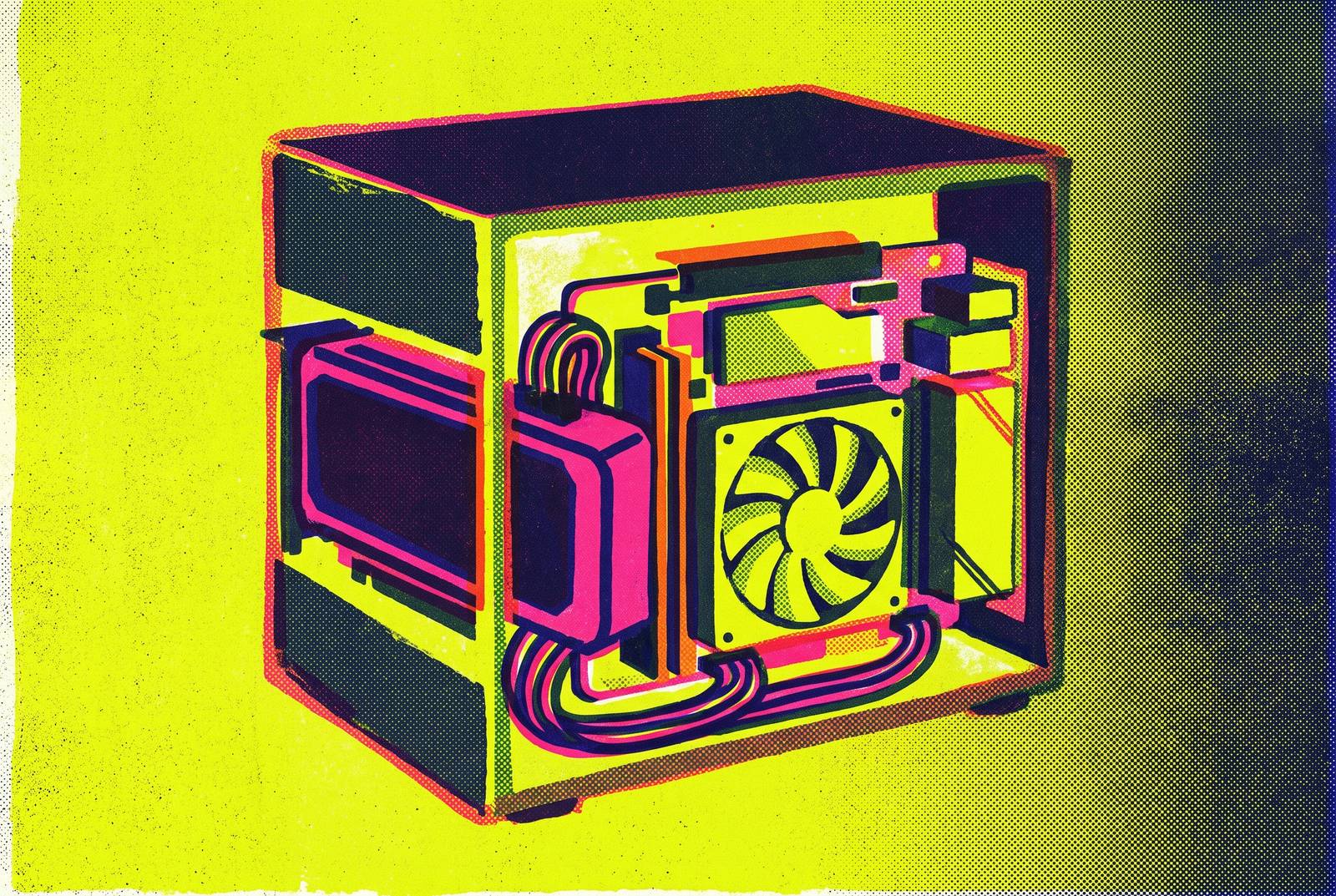
Small Form Factor PC building has emerged as a distinct subculture.
The community-accepted threshold places any build under 20 litres in SFF territory, a line the community drew itself and enforces on its own terms rather than one set by any manufacturer or standards body. For reference, a standard mid-tower case runs roughly 40 to 50 litres, so SFF builds sit below half that figure while still running identical processors, GPUs, and memory. Some builds push the boundary considerably further, reaching as low as 7 to 10 litres. Mini-ITX is the motherboard form factor that made the entire category possible, because it proved a full desktop platform could shrink that far without sacrificing real capability, and everything else in the classification, the cases, the coolers, the community itself, exists downstream of that proof.
What volume threshold defines an SFF build, and where does Mini-ITX fit in?
Small form factor building looks, from a distance, like a preference for smaller boxes on a desk. It's actually a subculture with its own values, its own vocabulary, its own landmark cases and forums, and an aesthetic philosophy that governs every hardware decision from the motherboard on up. Understanding what drives SFF builders shows the craft at its most deliberate, and its most constrained.
SFF is a formal classification. It covers desktop computers and the components built for them, chassis and motherboards designed specifically to cut volume and footprint below what a standard ATX build occupies. The silicon inside doesn't change. Only the box around it does, and that distinction is what determines how much volume a build can shed while still running identical internal components.
Mini-ITX is the board that made the whole category possible. Everything downstream of it, the cases, the coolers, the community itself, exists because Mini-ITX proved a full desktop platform could shrink that far without giving up real capability. That number is a figure the community arrived at and enforces on its own terms. It's a line the community drew itself and defends. A standard mid-tower reference case runs roughly 40–50 litres, whereas SFF builds sit below half that figure while still running the same processors, GPUs, and memory. The community-accepted threshold puts sub-20 litres in SFF territory, with some builds going as low as 7–10 litres.
The modern SFF scene's growth out of crowdfunded community projects
The scene didn't come out of a corporate product roadmap. It came out of the mid-2010s, when a handful of community-originated cases set out to prove that genuinely high-end hardware, not just budget office parts, could live inside a tiny enclosure. The Ncase M1, the Ghost S1, the DAN A4-SFX, and the Thor Zone MJOLNIR did that work. Every one of them started as a crowdfunded project, made possible by rapid prototyping tools that let small teams iterate on a chassis design without a factory behind them first.
Crowdfunding did more than pay for tooling here. It changed the relationship between builder and product. Backers weren't buying something off a shelf, they were putting money behind a concept that might not ship for months, which made them invested stakeholders who cared whether the thing actually worked once it arrived. Paying for a promise and waiting on it is baked into SFF culture in a way it never was for someone grabbing a case off a shelf at a big-box retailer.
3D printing and laser cutting opened the door to custom, one-off production, both for small manufacturers like Lazer3D and for individual builders with access to the same equipment. That's the part outsiders miss most: the tools that made mass production cheap are the same tools that made tiny-batch, single-person case design possible.
The values that organize SFF building: constraint as creative discipline
Every cubic centimetre inside an SFF case is a decision somebody made on purpose. A mid-tower has room to spare for mistakes. An SFF case doesn't, and that gap is where the whole subculture's value system comes from.
The order of operations flips here, and most newcomers get it backwards. In a mid-tower build, the standard approach picks the parts first and finds a case big enough to hold them after. SFF building runs the opposite direction: the case gets chosen first, and it becomes the constraint that generates every subsequent decision rather than the container that absorbs whatever got decided already. Anyone who treats an SFF case like a smaller version of that same old process is going to hit a wall the first time a GPU doesn't clear the side panel by four millimeters.
That's why SFF builders don't stumble into these builds by accident. The research load running in is higher than for a standard build, the tolerance for a wrong measurement is lower, and the result, when it comes together, feels more personally authored than something assembled off a generic parts list. The appeal, stated over and over across the community, is one clean box with nothing cluttering the desk, and that visual outcome operates as a design goal in its own right, not an afterthought.
The community spaces where SFF knowledge is built and shared
SFF.Network, at smallformfactor.net, is the central hub where this knowledge lives. As of September 2026 it carried 1,800 threads in the "First Hellos" introductory section alone, with 5,400 messages posted there https://smallformfactor.net/forum/. Its categories span articles, news, general Q&A, hardware discussion, build logs, case mods, concept threads, and a library of 3D model resources for people designing their own parts.
Builds and Concepts together hold more than 2,200 build threads and nearly 1,000 concept threads. That ratio says something specific: this isn't a forum that just discusses hardware, it's one that designs its own cases and pushes to get them produced.
[H]ard|Forum, a much older and more general hardware community, built a dedicated Small Form Factor Systems section of its own, and that section stays active rather than languishing. Its NCASE M2 builds and discussions thread has drawn 50 replies and 24,000 views, running alongside a "Noctua Mini-PC Sandwich" build log still being updated. A general hardware forum spinning off an SFF-specific subspace tells you the volume of dedicated conversation demanded it. SFFtime's N-ATX V2, a 15L evolution of a console-style case supporting ATX-size parts, is an active Concepts thread as of September 2026, and it shows how community design work moves toward real products.
GPU fitment and thermals as the hardest part of every SFF hardware decision
Graphics cards have gotten larger for years, and SFF cases have grown more sophisticated and more popular over that same stretch. That's a real tension, not a contradiction: case designers have had to out-engineer GPU growth just to keep the category alive. Cases designed before the RTX 4090 era, and before modern CPUs pushed thermal design power as high as they now sit, are functionally obsolete. They can't physically house or cool a current high-end card, full stop, no matter how the specs get argued.
Before buying a GPU, check the case's GPU length limit first. Most Mini-ITX cases cap around 320 to 340mm, though some premium shorter cases cap lower. The card takes up either two slots or three, and the case's clearance either allows a triple-fan card or it doesn't. Get any one of those wrong and the card doesn't go in the case. No amount of force considered.
The RTX 50-series shifted this calculus in the community's favor. Nearly every third-party manufacturer now offers at least one RTX 5080 variant built to fit a compact case, a far more inclusive list than what the RTX 4000 generation offered.
The case tier list SFF builders use in 2026
Treating these cases as interchangeable ignores that each one answers a different version of the same tradeoff, between volume, GPU clearance, airflow, and how the finished box looks sitting on a desk. Picking the wrong one for your priorities means living with the mismatch for years.
The Fractal Design Terra pairs an aluminum outer shell with a solid walnut front panel, fits most large GPUs despite its restrained footprint, and reads, by most accounts, as simply better-looking than the competition. It's the pick for builders who treat the visual result as the primary design target, not something bolted on after the parts list is finalized.
The SSUPD Meshlicious runs 14.6 litres and still fits a 280mm AIO liquid cooler alongside a three-slot GPU, an unusual combination for something this size, helped along by an all-mesh exterior built around airflow rather than looks. It's the case for builders who won't compromise on cooling no matter how small the box gets, and it beats the Terra outright when thermal performance matters more than shelf appeal.
The Evolv Shift 2 takes a different shape entirely: tall and narrow, small footprint, anodized aluminum panels, priced at $100 for the mesh version and $110 for the tempered glass variant with an addressable-RGB fan.
The Lian Li A4-H2O runs 11 litres and supports a proper AIO without pushing into the extreme dimensions the Dan Cases A4-SFX line occupies. It's the middle path between ultra-compact and genuinely liquid-cooling-capable, for builders unwilling to choose between the two.
The Dan Cases A4-SFX v4.1 shows up on the 2026 top Mini-ITX lists as the direct descendant of the original DAN A4-SFX, the community case that proved SFF gaming was viable back in the mid-2010s. The Cooler Master NR200P Max, Hyte Revolt 3, and NZXT H1 v2 also show up in 2026 top picks, each suited to a different budget and GPU size.
The NCASE M2 deserves separate mention for reasons beyond its spec sheet. Its dedicated build thread on [H]ard|Forum had drawn more than 24,000 views as of August 2026, and that level of sustained engagement is what makes a case a landmark rather than just another option on a list.
Given how unforgiving GPU fitment is in this category, skipping a visual planning tool before buying is close to reckless. BuildCores maintains a configurator backed by over 5,000 accurate 3D models, letting builders check GPU fitment and spot spatial conflicts inside these exact cases before money changes hands. In an environment with this little tolerance for error, that step is essential homework. A GPU either clears the side panel or it doesn't.
CPU cooling in SFF: the height clearance hierarchy every builder needs to understand
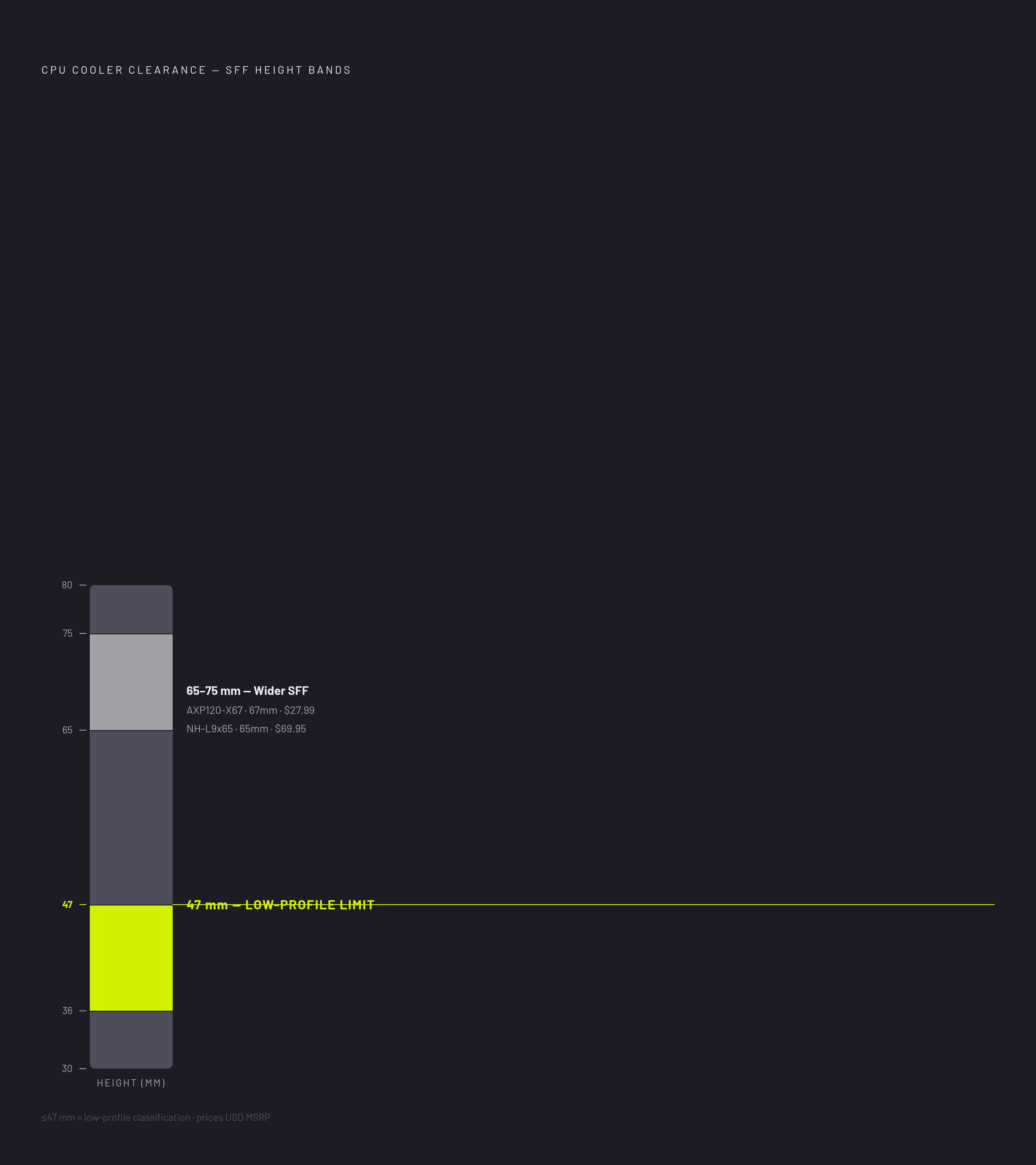
One number governs which CPU coolers are viable in a given SFF case and which are physically impossible: height clearance, in millimetres.
The bands break cleanly enough to memorize. Anything at 47mm or under earns the "low-profile" classification https://buttondown.com/nazarin/archive/mini-itx-gaming-pc-build-guide-2026-big/. Coolers running 65 to 75mm work in wider SFF cases or slim ATX towers, where there's a bit more vertical room to spare https://buttondown.com/nazarin/archive/mini-itx-gaming-pc-build-guide-2026-big/. Coolers in the 36 to 45mm range fit the slimmest Mini-ITX and thin-HTPC enclosures.
Mini-ITX boards complicate this hierarchy further, and not in a way spec sheets make obvious up front. Densely packed board features, expansion headers, and VRAM heatsinks eat into the practical legroom a cooler needs, even when that cooler technically fits a standard board on paper. Noctua built the NH-L12Sx77 specifically to answer this problem: a taller SFF-focused variant of the NH-L12S, adding height and two more heatpipes over the previous generation.
For overall SFF gaming use, the Thermalright AXP120-X67 is the default recommendation, and there's little reason to look past it first. At 67mm tall and priced around $27.99, it covers the widest range of case compatibility of anything in this tier https://www.propelrc.com/best-low-profile-cpu-coolers/. For ultra-compact builds at 37mm, the Noctua NH-L9i-17xx chromax.Black gets called the "undisputed champion" for low-profile Intel cooling on LGA1700 and LGA1851 platforms. On a tight budget, the Thermalright AXP90 X36 stands out: 36mm tall, rated for up to 95W of TDP, running at a nearly silent 22.4dB, and priced under $21 https://www.propelrc.com/best-low-profile-cpu-coolers/. For builders who want quiet and longevity over price, the Noctua NH-L9x65 runs $69.95 and carries a 6-year warranty, and gets treated as the standard for that priority https://propelrc.com/low-profile-cpu-coolers/.
A complete 2026 SFF gaming build, component by component
Start with the CPU, because in SFF it anchors every thermal decision that follows. The Ryzen 7 9700X runs a 65W TDP, and that's a deliberate choice that keeps the rest of the build manageable, not a compromise the small case forces on the builder https://buttondown.com/nazarin/archive/mini-itx-gaming-pc-build-guide-2026-big/. X3D variants of the same chip run hotter, cost more, and complicate the thermal picture enough that they should get skipped unless the extra cache actually matters for the games being played.
The platform underneath is AM5, on either a B650I or X670I board, a mature platform with support stated to run through the Zen 6 generation. That continuity matters more in SFF than in a standard build. The case and the cooler represent a real financial commitment of their own, and a motherboard that survives multiple CPU generations keeps that commitment from repeating every upgrade cycle. The I/O that ships on the board is what the build lives with for its entire service life, since there's no rear expansion slot to bail it out later.
Motherboard selection in SFF comes down to a short list of checks, and skipping any one of them causes problems months later rather than at the register. M.2 slot count should be two, ideally, since a single-slot board forces an awkward choice between storage capacity and speed. VRM quality needs checking in reviews specifically, because cramped VRMs on a small board overheat under sustained load in ways a spec sheet won't show.
The SSUPD Meshlicious has a volume of 14.6 liters https://buttondown.com/nazarin/archive/mini-itx-gaming-pc-build-guide-2026-big/. The Lian Li A4-H2O has a volume of 11 liters https://buttondown.com/nazarin/archive/mini-itx-gaming-pc-build-guide-2026-big/. The Evolv Shift 2 mesh version is priced at $100 https://buttondown.com/nazarin/archive/mini-itx-gaming-pc-build-guide-2026-big/. The Evolv Shift 2 with tempered glass and addressable-RGB fan is priced at $110 https://buttondown.com/nazarin/archive/mini-itx-gaming-pc-build-guide-2026-big/. 36–45mm coolers fit the slimmest Mini-ITX and thin-HTPC enclosures https://buttondown.com/nazarin/archive/mini-itx-gaming-pc-build-guide-2026-big/.