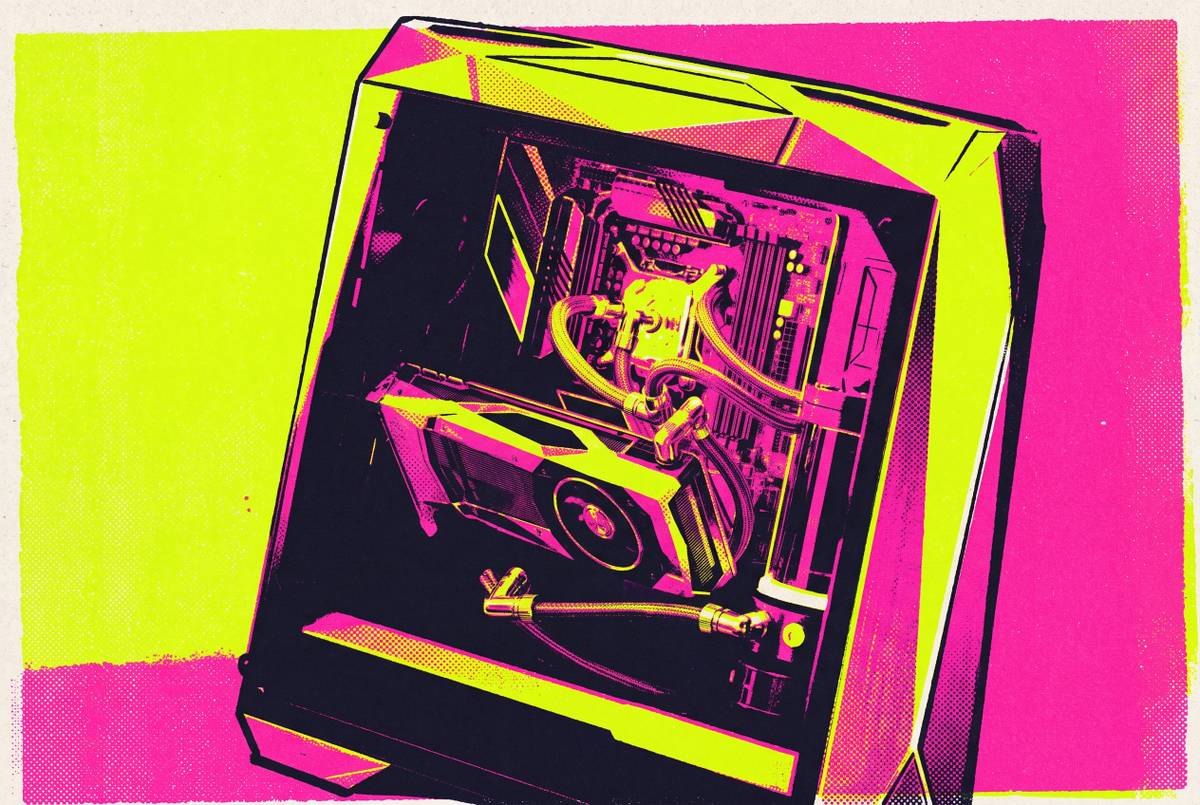
Watercooling Culture and the Role of Craft in Enthusiast Building
Custom watercooling is engineering, furniture-making, photography, and ritual combined into one.

Watercooling has always been about more than temperatures, and the rituals around it, the planning, the routing, the showcasing, matter to enthusiasts as much as the thermal numbers do. The gap between the engineering justification and the actual behavior is where this piece starts: it shows that the rituals of watercooling, not just the specs sheet, drive builder behavior.
Custom loop builders treat maintenance as ritual because the draining and refilling cycle, scheduled every 18 to 24 months, is understood as a deliberate return to the machine rather than a burden to minimize. The AIO exists to be forgotten once mounted; the custom loop is designed to be returned to, and that difference in relationship is the point. Coolant choice, loop topology, tubing routes, and the leak-test vigil before any expensive component goes near the filled system are all decisions that carry the builder's authorship through the life of the build, not just its assembly. That sense of ongoing authorship shapes build decisions at every stage: cases are chosen for how well they frame the loop as a visual centerpiece, components are selected partly for how coolant will look moving through them, and the maintenance window itself is treated as a scheduled re-engagement with something made, not merely installed.
Inside the community, the word "loop" is never thrown around casually. Say it in the wrong context and you'll get corrected, because it signals membership, a specific kind of investment, and a philosophy about what building a PC is supposed to be. Watercooling sits at an intersection of four disciplines that rarely get named together: engineering, furniture-making, photography, and ritual. The short version is that a custom loop asks a builder to solve a thermal problem, build an object meant to be looked at, compose it for a camera, and treat the maintenance cycle as something closer to a ceremony than a chore.
The scale of the shift matters here too. Alibaba Electronics research puts AIO cooling in 45% of new gaming PC builds, up from 28% in 2023 Gaming PC Water Cooling Guide: How to Choose Right in 2026 Gaming PC Water Cooling Guide: How to Choose Right in 2026 formulamod.net PC Water Cooling System Guide: How to Choose Right in 2026. It would be easy to read that as liquid cooling simply winning the argument against air. Mainstream adoption hasn't diluted the custom-loop identity, it has sharpened it. Once the AIO absorbed the pragmatic case for liquid cooling, the sealed unit that anyone could drop in without opening a wrench, custom-loop builders were left to represent something more intentional, and they've leaned into that fully. The thermal case for liquid cooling is real but insufficient to explain enthusiast behavior, as people routing soft tubing at midnight for the fourth time are not optimizing for 4–7°C computerheaven.net.
Modern hardware and the return of liquid cooling as a real engineering problem
None of this would carry the same weight if the thermal stakes weren't real, and this generation of hardware they are. That's the gap between a card throttling under sustained load and one running at full boost clocks indefinitely, and it's why the high end of this hobby isn't theater dressed up as engineering.
Air cooling still has a respectable ceiling. That's the art form's limit, not a floor to build past computerheaven.net PC Water Cooling System Guide: How to Choose Right in 2026.
The engineering frontier keeps moving, too, and the industry isn't waiting for enthusiasts to catch up on their own. Inno3D's GeForce RTX 5090 and RTX 5080 iCHILL Frostbite Pro cards ship with a pre-installed Alphacool single-slot water block straight from the factory. That's a hardware manufacturer building watercooling into the product itself, rather than leaving it to the aftermarket, and it's evidence that the top tier of this industry is converging on liquid cooling as default infrastructure. Against that backdrop, the people solving this problem with their own hands aren't playacting. They're responding to real thermal physics that air simply can't move fast enough to handle. Active backplates are entering the conversation not as aesthetics but as functional necessity for cards with power spikes above the 575W baseline, signaling that the engineering frontier is moving ekwb.com.
Why do custom loop builders treat maintenance as ritual rather than a chore, and how does that shape their builds?
An AIO is infrastructure Gaming PC Water Cooling Guide: How to Choose Right in 2026 Gaming PC Water Cooling Guide: How to Choose Right in 2026 formulamod.net PC Water Cooling System Guide: How to Choose Right in 2026.
A custom loop asks for the opposite kind of commitment. Every part gets chosen by hand, and every connection between the pump and reservoir, the radiators, the water blocks, the tubing, and the coolant is assembled. The maintenance schedule reflects that difference. Draining and refilling a loop every 18 to 24 months isn't treated as a burden by the people who do it, it's a scheduled return to the machine, a deliberate re-engagement with something they built computerheaven.net. Compare that to an AIO, which is designed to be forgotten about entirely once it's mounted Gaming PC Water Cooling Guide: How to Choose Right in 2026 Gaming PC Water Cooling Guide: How to Choose Right in 2026 formulamod.net PC Water Cooling System Guide: How to Choose Right in 2026.
That's exactly the point. Nobody building a custom loop is doing it because they ran the numbers and found the AIO thermally inadequate Gaming PC Water Cooling Guide: How to Choose Right in 2026 Gaming PC Water Cooling Guide: How to Choose Right in 2026 formulamod.net PC Water Cooling System Guide: How to Choose Right in 2026. First-time builders routinely spend upward of 10 hours on assembly alone, and the community doesn't treat that time as wasted or inefficient computerheaven.net. It's the price of participation. AIO pump failure rates are 4 to 6% over five years, compared to well under 0.5% for air coolers computerheaven.net. Custom loops demand discipline and ongoing maintenance to hit comparable reliability, and that discipline is part of the bargain enthusiasts have made peace with, not a flaw they're ignoring. AIOs function as infrastructure (pre-filled, sealed for 5–7 years, with virtually no maintenance, OLED pump heads, and ARGB), having absorbed the pragmatic and now also the aesthetic mainstream PC Water Cooling System Guide: How to Choose Right in 2026. 20% of surveyed buyers cite clean aesthetics and customizable RGB as their top reason for choosing AIOs, evidence that even the mass-market option is now an identity product. This finding appears in a 2026 decision guide on whether water cooling is worth it.
The rituals that define custom loop building as craft
Before a single fitting gets tightened, a builder has to decide on loop topology: whether coolant hits the CPU block before the GPU block or after, where the radiators sit in the case, how high the reservoir mounts, whether the fill port stays reachable once the motherboard tray goes back in. None of those decisions are purely technical. They reflect a builder's philosophy about how the machine should behave and how it should be lived with, long after the parts list is finalized.
Routing the tubing itself is a distinct skill, and the two disciplines within it barely resemble each other computerheaven.net. Soft tubing rewards heat and patience, coaxing a flexible line around a radiator mount without kinking it. Hard tubing, whether PETG or acrylic, punishes imprecision: every bend has to be measured, cut, and heat-formed to an exact angle, and a mistake appears as a visible flaw in a piece that's otherwise meant to look architectural. There's no hiding a bad bend behind a side panel in a case built around glass.
Then comes the leak test, which has no real equivalent anywhere else in PC building. The loop gets filled with distilled water before any expensive component goes anywhere near it, the pump runs for hours, and the builder just watches for drips. Coolant color is arguably the most personal call in the entire build, since it defines the loop's whole visual identity and stays locked in until the next drain cycle forces a change. And the finished loop almost always ends with a photograph, lights off, RGB on, framed like a still life. That photograph isn't documentation of the build. It's the actual point of having built it. Community threads bear this out consistently: the Lian Li O11 Dynamic XL and the Fractal Design Torrent appear repeatedly as the vessels of choice because their internal layouts are built around the loop as the visual centerpiece, not an afterthought tucked behind a shroud.
Case design, the "fish tank" aesthetic, and the codification of loop culture into hardware products
Community sources have a specific name for the look that's come to define showcase builds: the "fish tank" aesthetic. Cases built around that philosophy include the Lian Li O11 Dynamic XL, the Fractal Design Torrent, the Lian Li Lancool 216 (an ATX mid-tower that also fits E-ATX boards), and the Corsair 4000D RS ARGB, which pairs its InfiniRail mounting system with the BTF and Zero-connector compatibility now offered by ASUS, MSI, and Gigabyte. None of that is incidental. Each of those design choices exists because the case stopped being a box and started being a frame.
That's the real arc here: the PC case moved from a functional enclosure into what community sources describe outright as "the artistic centerpiece" of the build, and watercooling is the content that made that transformation legible in the first place. A glass panel means nothing without something worth looking at behind it. EKWB's EK-Quantum Vector³ water block lineup for the RTX 5090 and RTX 5080 makes that logic explicit at the component level: its CNC-machined cast acrylic top is designed specifically to showcase coolant flow, and EK-Matrix7 compatibility is pitched as simplifying integration for builders assembling exactly this kind of showcase system. Even AIOs have picked up the same instinct at a smaller scale Gaming PC Water Cooling Guide: How to Choose Right in 2026 Gaming PC Water Cooling Guide: How to Choose Right in 2026 formulamod.net PC Water Cooling System Guide: How to Choose Right in 2026. OLED pump-head displays now show up in roughly 38% of premium builds Gaming PC Water Cooling Guide: How to Choose Right in 2026. Even the mass-market tier has absorbed the underlying principle: cooling is meant to be visible, not hidden behind a fan shroud Gaming PC Water Cooling Guide: How to Choose Right in 2026. An entire product category has been built on the assumption that the loop will end up photographed, and that's not the industry pandering to vanity, it's a legitimate design constraint, one that watercooling culture created and the hardware industry has simply followed. The "fish tank" aesthetic is named explicitly, involving removing the front corner pillar and installing seamless front and side tempered glass panels for an uninterrupted view of the hardware, described by community sources as transforming GPUs, custom loops, and RGB lighting into "kinetic art pieces".
The block ecosystem as a map of the enthusiast supply chain
How fast the water-block market moves around a new GPU launch gives a pretty accurate map of how seriously this ecosystem takes itself ekwb.com formulamod.net. EKWB's EK-Quantum Vector³ line for the RTX 5090 and RTX 5080 ships with an expanded cooling engine, upgraded thermal pads, and a precision-engineered gasket system covering the GPU core, VRAM, and power stages, with an included backplate that handles passive cooling on its own. Alphacool took a different route with its Core GPU water cooler for the RTX 5090, 5080, 5070 Ti, and 5070, redesigning the block from the ground up so every distance between the cooler and the PCB's components is adjusted precisely for that specific card. Alphacool backs that up with a dedicated GPU Configurator tool, which exists because matching a block to the correct GPU variant has become genuinely fragmented and hard to get right by eye.
Bykski, meanwhile, competes on speed, and in a culture built around wanting to build now, that turnaround time is a real competitive edge. None of this happens in a vacuum of goodwill, either. Survey data out of r/watercooling shows EKWB's preference among builders declining, down 22% since 2024, largely attributed to reported quality-control inconsistencies on newer GPU blocks. Community trust here is granular and updates fast, which sets this market apart from most consumer hardware categories, where brand loyalty tends to calcify. Every new GPU generation sets off the same cycle across all three brands: a wave of block development, compatibility documentation, and community testing, treated less like a routine product refresh and more like a launch event for the loop-building culture itself. Bykski's N-RTX5090FE-SR series serves the Founders Edition, with AIB-specific models following a consistent naming convention such as N-MS5090DTRIO-X for MSI and N-AS5090ASTRAL-X for ASUS ROG Astral, and Bykski typically releases compatible blocks within 2–3 weeks of a new GPU launch, making speed to market a competitive differentiator in a culture that wants to build now.
The aesthetic sub-cultures within watercooling: from maximalist RGB to monochrome restraint
That was the aesthetic of maximum visibility, spectacle for its own sake, and for a long stretch it was more or less the only language the community spoke. That aesthetic has changed. Minimalist and monochrome builds now carry equal prestige in community threads, a shift that sources say has been building for roughly three years. Restraint, it turns out, takes just as much planning as spectacle does, sometimes more, since there's nowhere to hide an inconsistency when the whole build is one color.
Cable management has become its own discipline inside that shift. The recurring feedback in showcase threads is some version of "love the build, fix the cables," which has pushed cable elimination from an afterthought into a primary aesthetic concern, and BTF and Zero-connector motherboards exist directly because of that pressure. Watercooling stays the common thread running through nearly all of it at the high end.
That plurality reads as a sign of maturity rather than fragmentation. A hobby with one accepted look is a young hobby. One that supports several competing definitions of what a great build looks like, while still holding everyone to the same standard of deliberate, visible, photographable craft, is a hobby that's figured out what it actually values. The historical baseline shows that early showcase culture was full-RGB, glass-paneled, and Instagram-facing, embodying the aesthetic of maximum visibility and spectacle. Thematic sub-genres beyond the RGB/minimalist axis (wall-mounted rigs, themed décor, AI-powered lighting, and modular desks) show that the community has diversified what a "showcase build" can mean, with watercooling remaining the common thread at the high end.
Planning a custom loop before buying anything: where the craft begins
The planning problem in custom loop building is not a formality; it's where most of the real craft actually happens. Loop topology, radiator sizing, component compatibility, tubing path, coolant color, and case fit all interact with each other, and a mistake made in planning gets expensive and time-consuming to walk back once the parts are already sitting on a bench. That's arithmetic that belongs on paper well before assembly starts, not something to discover mid-build when a radiator doesn't fit where it was supposed to go.
There's a visual side to planning too, one that runs in parallel with the thermal math. Serious builders mock up tubing routes, coolant colors, and component placement in their heads or on paper long before anything gets ordered, treating the loop as an imagined object first and a physical one second. Tools built for that exact stage have started to matter more, letting a builder see a case, a GPU block, and a full loop rendered together, alongside a component library large enough to actually reflect what's available, before a single part gets purchased. Paired with a performance baseline (an estimate of what a given GPU and loop configuration should deliver in real frame rates) that kind of tool gives a planner a concrete target to build toward, confirming the investment is worth making before the first fitting ships ekwb.com. Community purchasing data adds a further layer, since it shows a first-time builder what other people are actually running in their loops, rather than what a single benchmark chart insists they should be running. For a hobby where planning is itself a form of participation, a tool that makes that planning stage feel as engaging as the build itself is a genuinely native part of it. Radiator math functions as a planning discipline: for a combined CPU and GPU loop on a 575W GPU like the RTX 5090, thermal testing data recommends 480mm or more of total radiator surface (a dual-radiator setup of one 360mm and one 240mm, or a single 480mm) to keep both components under 60°C, a calculation that belongs in the planning phase, not the assembly phase ekwb.com.
Watercooling culture and the future of enthusiast building
That belief is the actual subject of this piece, more than any single component or technique.
The AIO's rise doesn't threaten that belief, it clarifies it Gaming PC Water Cooling Guide: How to Choose Right in 2026 Gaming PC Water Cooling Guide: How to Choose Right in 2026 formulamod.net PC Water Cooling System Guide: How to Choose Right in 2026. By absorbing the pragmatic case for liquid cooling entirely, sealed, low-maintenance, good enough for the overwhelming majority of builders, AIOs have freed custom loops to be the high end of the hobby, where effort and intention are the actual product, not a side effect of chasing lower temperatures. The social layer isn't fading either. Build-sharing culture, the prestige attached to a well-lit hero shot, the specific vocabulary builders use, topology, flow path, fill port, all of it marks out a community that takes its own craft seriously and recruits new members by holding them to shared standards rather than lowering the bar to welcome them in. That's not a hobby cooling off. It's one settling into what it was always building toward. The convergence of hardware and culture (575W TDPs, fish-tank cases, acrylic block tops designed to be photographed, GPU configurator tools, and community threads debating coolant compatibility) expresses the same underlying value: the belief that a PC build is something you make, not something you assemble ekwb.com. The global liquid cooling market stands at $240.