Demographic Shifts in Who Builds PCs and Why
Women and creative professionals are joining gamers as PC builders, reshaping who powers the hobby.

The PC-building community has moved well past its old image of a solitary tinkerer in a basement, pulling in women, younger first-timers, athletes, and creative professionals alongside the enthusiasts who built the hobby's reputation in the first place. What's changed isn't just who shows up to build, it's why they do it: cost control, performance, aesthetics, identity, and belonging now sit side by side as legitimate reasons to open a case and start seating components.
How the "typical PC builder" became a fiction
The stereotype used to write itself. The stereotype was someone solitary, male, technically inclined, who'd rather read a motherboard manual than go outside. Aranibar of ScatterVolt, speaking to Sandisk in June 2026, said it used to be "the nerds and geeks". That's not a caricature invented for this piece, it's how someone inside the community describes what the community used to look like.
Aranibar's next observation matters more than the first. Over the last five to ten years, building a PC has become, in his words, kind of cool, and now athletes, actors, and people nobody would peg as hardware enthusiasts are doing it. Derek Hockman, also speaking to Sandisk, reframes the whole question of identity: what defines the community isn't a demographic box anymore, it's a disposition. Builders and tinkerers, in his phrase, "in a very traditional sense". The label stopped being about who you are and started being about what you do with a screwdriver and a parts list.
None of this is just vibes from people close to the hobby. The ESA's 2025 Essential Facts report puts U.S. gamers at 47% women and 52% men, a gap that has closed steadily over two decades, and Women in Games' 2025 figures put women at 46% of gamers worldwide. That's the pool builders are drawn from, and it's no longer a narrow one. Gaming's demographic broadening is the upstream condition that feeds builder diversification, not some unrelated trend running in parallel.
Why women entering gaming en masse matters for who builds
Women in Games didn't hedge its 2025 framing: at 46% of all gamers worldwide, treating women as an "emerging" audience in gaming is no longer defensible. An audience that size isn't emerging. It has arrived, no longer just emerging.
The generational breakdown holds a genuine surprise. ESA's 2025 data shows 52% of boomer women play video games, compared to 46% of boomer men, and the gender inversion that gets discussed as a future trend has already happened at the older end of the age range. That cuts against the assumption that gaming (and by extension, building) skews young and male by default.
So why doesn't builder community representation already match those gaming numbers? Part of that friction is environmental. Bryter's research found 59% of women experienced toxicity from male players in 2024, down from 72% in 2022. The improvement is real and shouldn't be understated, but a hobby-adjacent community that's still a deterrent to well over half its female participants isn't yet a hobby-adjacent community that feels open by default.
Hardware brands have started treating this as more than a public relations exercise. CORSAIR for Business became the presenting partner for the theGameHERs Awards 2026 in a December 2025 partnership, celebrating 100 women across gaming and esports and committing to education and career-pathway programming. That kind of investment signals something specific: inclusion, for a hardware company, is a market bet as much as a values statement. The conditions are converging. A broader gaming base, declining (if not eliminated) toxicity, and industry money moving toward inclusion all point the same direction. The builder community is likely to track gaming's gender shift with a lag, not stand apart from it as some kind of exception. A gap persists between gaming participation and builder community representation, since gaming numbers don't automatically translate into PC building numbers, raising the question of where the friction lies.
The other new builders: remote workers, creators, and the cost-motivated first-timer
Gender is one axis of change. Use case is another, and it might be the more underappreciated one. Amazon data shows home office workers make up 38.44% of primary users of high-end motherboards, with home office use as the single leading usage scenario at 57.3%. That's a home office worker who needed reliable performance, not the enthusiast profile at all. That's someone who needed a machine that could handle video calls, spreadsheets, and maybe some light editing, and decided building was the more sensible route to get there.
Workstation builds for creative professionals grew 31% year-over-year according to market data, which marks out an entirely separate group with its own component priorities: storage throughput and render times matter more to this crowd than frame rates ever will.
Then there's the first-timer who builds purely because the math works. Danny Le, who runs NerdOnABudget, told Sandisk his first build cost $300 in parts and matched the performance of a $600 prebuilt at the time. No prior enthusiasm for the craft required, just arithmetic. Agragati Siegel came in through a different door entirely, professional repair work, where noticing how prebuilts cut corners on motherboards, storage, and power supplies turned into its own motivation: not raw savings, but informed control over what actually goes into the box. Le also points out that building opens up the secondhand market in a way prebuilt purchasing never does, used components that are, in his words, "perfectly usable," the way used car parts are. That's an avenue closed off entirely to someone buying off a shelf.
Putting those pieces together shows a picture that is already plural by use case before it's plural by anything else. Gaming holds 54% market share among builder applications, sure, but that leaves a substantial share of the community building for productivity, content creation, and hybrid work setups. The community was never as gaming-monolithic as its reputation suggested.
What the 2026 pricing crisis is doing to who can afford to build at all
Then 2026 happened to memory prices, and the arithmetic that drew people like Le into the hobby stopped working the way it used to. Those aren't typos, and they aren't isolated to one retailer's index either. 3DCenter's retail survey put the DDR5 price index at 486% of its July 2025 baseline, up from 445% just the month before, a 9.2% month-over-month jump that leaves tracked DDR5 products at roughly 4.9 times their price from just over a year prior.
The knock-on effect on full builds is the number that actually lands. Tom's Hardware tracked a $4,000 dream build that cost $4,845 in late 2025, and the same configuration priced out at $7,407 under 2026 conditions across RAM, storage, and video cards. Global PC shipments are now expected to decline 11.3% in 2026, a sharp revision from the -2.4% outlook published as recently as November 2025, with machines under $500 taking the worst of it while premium systems hold up comparatively well.
That last detail is the tell. When the cheap end of the market absorbs the damage and the premium end shrugs it off, the people getting priced out aren't the enthusiasts with disposable income to spare, they're the budget-motivated first-timers the hobby has depended on for its newest blood. Some current buying guides have started advising readers to check prebuilt pricing first, because in 2026 the prebuilt is sometimes the cheaper option. That single piece of advice undoes the exact on-ramp that brought people like Le into building in the first place. The crisis functions as a regressive filter: it prices out the budget-conscious newcomer first, while leaving enthusiast and professional builders, who tend to have more room to absorb a bad year of component pricing, largely undisturbed. Tom's Hardware's index put a mainstream 32GB DDR5-6000 kit at $392 as of August 2026, up from $110–140 in Q3 2025, while a 2×32GB DDR5-6000 kit went from $222 to $1,272 (a 473% increase) and a 2×16GB kit climbed from $108 to $572 (a 429% increase).
Why people build: the motivations that have diversified alongside the community
Cost and control sit at one end of the motivational spectrum.
Craft and challenge sit somewhere else entirely. Aranibar describes building as what amounts to an autotelic exercise, done for the doing of it, where skill acquisition and future-proofing become a form of problem-solving in their own right. Hockman goes further, describing builders who set themselves self-defining problems: the smallest possible PC, a case built from wood, liquid cooling routed through hand-bent copper pipe. That's precisely the point, the constraint is invented for the sake of solving it.
Community and identity make up a third strand, less measurable but no less real: building for a friend, building to prove to yourself that you can, where the finished machine is almost secondary to the process and the sense of belonging that process generates.
A motivation appears only after someone has already joined the community. Le has said building changed his entire relationship with technology, and that concerns about e-waste and rare earth mining only entered his awareness through being part of the community, not before it. That's a hook that draws almost no one in on day one. It's a value that compounds the longer someone stays.
Aesthetics round out the picture, and they cut in two directions at once. RGB lighting customization shows up in roughly three-quarters of enthusiast builds by current market estimates, while a visible counter-current has grown toward minimalism, Fractal Design's North line leans on Scandinavian-inspired minimalism and natural materials specifically to blend into living spaces, with no RGB bundled in at all. Some builders lean into theme instead of either extreme, designing around cyberpunk or fantasy concepts where the PC functions as a storytelling object rather than a plain tool. None of these motivations rules out the others. A single builder might be chasing a better price, solving a self-imposed engineering puzzle, and matching a minimalist aesthetic all in the same build, and increasingly, that's what's happening. Le (Sandisk, June 2026) points to cost arbitrage as the original entry point for building, while Siegel (Sandisk, June 2026) points to control over component quality and long-term reliability as the professional's motivation.
Aesthetics and setup culture as a distinct entry point for new builders
The PC has become something people look at as much as something they use. Modders HQ's 2026 framing captures it well: every component now tells a story, from the cooling loop to the case design itself. Open-frame builds function as showcase pieces now, and transparent side panels have gone from a premium upsell to something close to a default expectation.
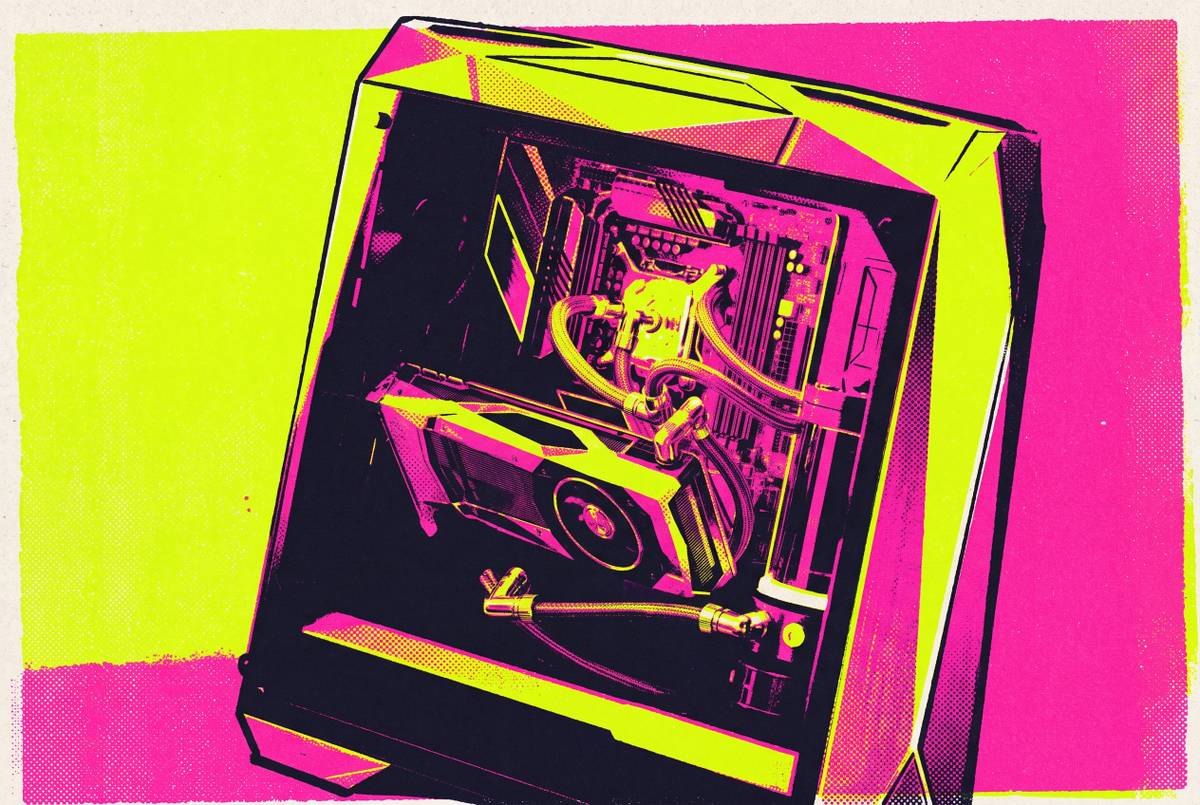
Cooling is the clearest example of function turning into display. Water-cooled systems have picked up 22% more adoption since 2022 according to market data, and a chunk of that growth has nothing to do with squeezing out extra thermal headroom. It's about the loop looking good behind glass. Small form factor builds, which now account for 18% of total market volume, chase a related but distinct goal: a clean, compact presence on a desk that doesn't dominate the room.
Case manufacturers have noticed, and they're marketing accordingly. HYTE maintains a standing guide on building a complete PC setup aesthetic, treating the case as one piece of a room's overall design rather than a spec sheet with a price tag attached. A Newegg community post from September 2025, nicknamed the "Coffeematic PC," fused a coffee maker with a PC build and drew reactions like "This is me as a computer", a moment of self-recognition in a piece of hardware. That's a moment of self-recognition. That's someone recognizing themselves in a piece of hardware, which is a different kind of engagement with the hobby entirely.
The RGB maximalist and the minimalist look like opposites, and in a narrow sense they are, but both are expressions of the same underlying shift: the PC build as personal statement, they disagree on vocabulary, not on the premise that aesthetics matter. They disagree on vocabulary, not on whether aesthetics matter in the first place. And this matters for demographics specifically because aesthetic and setup culture travels through social platforms and livestreams, reaching people who've never watched a hardware benchmark video in their lives, including plenty of younger builders and women who found their way into the hobby through a desk photo, not a spec sheet. BuildCores' 3D configurator and setup builder directly serve this motivation, letting builders visualize the full desk aesthetic before committing to any component rather than working from a spreadsheet of specs.
What planning tools reveal about how the builder identity has changed
The old model assumed a certain baseline of technical fluency before anyone touched a component: compatibility researched by hand, prices tracked across a dozen open browser tabs, aesthetics imagined rather than seen. That model made sense when the community was narrower and more self-selecting. It makes a lot less sense now.
The newer mix of builders, first-timers chasing a price, remote workers who just need a reliable home office machine, aesthetic-driven builders working backward from a desk photo, creative professionals optimizing for render times, is just as serious about the craft. They're differently equipped for it, and they need tools that show compatibility, pricing, and visual output all at once rather than one after another in sequence.
That's part of why AI-assisted configuration has started showing up across global marketplaces, per Modders HQ's reporting, with recommendations built around workload, budget, and aesthetic preference together, functioning less like a premium add-on and more like a baseline expectation. In a market as volatile as 2026's, planning matters more than it used to, not less, and committing to a build without checking real-time pricing and compatibility against a market moving this fast is a considerably more expensive mistake than it would have been a year earlier.
Planning tools built around a 3D configurator with real-time compatibility checks, multi-retailer price comparison, and performance estimation through benchmarks like 3DMark, Cinebench, and Passmark are serving a genuinely diverse audience with real needs. They're serving a visualization need addressed by a 3D configurator with real-time compatibility checking, multi-retailer price comparison, FPS estimates via 3DMark, Cinebench, and Passmark integration, and a setup builder, useful in equal measure to a first-timer and to someone assembling a $4,500 aesthetic showcase build. Monthly hardware surveys drawn from actual purchasing data add another layer worth taking seriously, since sponsored benchmark charts don't always reflect what builders across different budget tiers are genuinely choosing to buy.
The tools that used to be optional conveniences for an expert crowd have turned into load-bearing infrastructure for a crowd that's genuinely diverse now, in background, in budget, and in what they're even trying to build toward. Given where builder demographics are headed, visual and interactive planning is standard practice for a much broader range of people. It's fast becoming the standard way anyone does this at all.
Sources
- The Case for Building Your Own PC in 2026 | Sandisk
- Modern PC Customization Build Trends 2026
- PC Build Trends 2026: AI, Pricing & Supply Chain
- Newegg Gamer Community
- 60% of PC gamers have no plans to build a new PC in the next two years — AI pricing crunch on RAM and other components paralyze enthusiast market | Tom's Hardware
- www.businesswire.com