PC Building's Place in the Broader Maker Movement
Technical mastery and personal identity merge in a hobby that keeps growing despite rising costs.

PC building has become the most widely practiced expression of the maker movement, a hobby where technical skill, creative choice, and group identity all show up in the same box of parts. Understanding why that convergence happens explains something that looks, on paper, irrational: the hobby keeps growing even as component prices climb and cheaper, easier alternatives multiply. That's the argument this piece makes, and the data backs it up.
PC building's place in the maker movement's longer history
The modern maker movement has an origin point most people outside it don't know: Dale Dougherty launched Make: magazine in 2005, then started Maker Faire in 2006, and it was Dougherty who coined the word "makers" for the hands-on crowd the magazine was written for 2026 PC Budget Allocation Guide: How to Build a PC During Memory Cris…. Maker Faire has grown considerably since then 2026 PC Budget Allocation Guide: How to Build a PC During Memory Cris….
The umbrella that Maker Faire covers is deliberately wide 2026 PC Budget Allocation Guide: How to Build a PC During Memory Cris…. Robotics, Arduino and Raspberry Pi projects, amateur rocketry, 3D printing, CNC machining, laser cutting, metalworking, cosplay, biohacking, repair cafes, sustainable living practices: all of it counts. PC building doesn't appear as an official exhibit category on that list, but it shares the same values driving everyone who does show up. Hands-on assembly, iterative problem-solving, knowledge passed peer to peer, and the basic satisfaction of making something that's unmistakably yours: those are the same impulses whether someone is soldering a robot arm or seating a graphics card.
What separates PC building from most other maker disciplines is what happens after the making stops. A finished PC build gets used every day, for work, for games, for whatever the owner needs a computer for. That daily utility pulls in people who might never call themselves makers otherwise, which is part of why the hobby's reach extends so far past the traditional hobbyist core. None of this makes PC building the largest or most important expression of the maker impulse just yet. That claim has to be earned with evidence, and it comes later. For now, the point is narrower: PC building is a legitimate, recognizable branch of the same tree. Maker Faire's 2026 scope, as described on makerfaire.com, includes the Bay Area flagship event on September 25–27, global faires in Rome, Paris, Hannover, and Shenzhen, featured faires in Orlando, Cairo, Prague, Miami, and Los Angeles, community faires in Bilbao, Lynchburg, Gent, Edmonton, and Tulsa, and school faires at the primary, secondary, and collegiate levels 2026 PC Budget Allocation Guide: How to Build a PC During Memory Cris….
The maker identity's strong resonance with PC builders specifically
Builders, when asked why they do it, rarely mention money saved. He described the process as an exercise in future-proofing, with the builder constantly anticipating what might fail or what might need replacing down the line, and planning around it.
Derek Hockman, who works in internal SSD marketing and strategy at SanDisk, framed the same instinct from a different angle in that piece noobfeed.com bottleneckcalculator.tech builttofrag.com gaminglikeaboss.com. He pointed out that builders spend much of their time inventing their own problems to solve: making a PC as small as physically possible, building a case out of wood instead of metal, running liquid cooling through hand-bent copper pipe. Nobody assigns those constraints. Builders choose them, on purpose, because the constraint is the fun part.
That's the same logic that governs plenty of other maker disciplines. A carpenter who wants a table could buy one at a furniture store. A PC builder who wants a working computer could buy one pre-assembled. In both cases, the decision to build instead of buy is the actual message being sent, an identity statement dressed up as a practical purchase. There's a secondary payoff too. Builders pick up real technical literacy along the way: how power supplies age, how heat moves through a case, why dust buildup matters, what happens to old components once they're replaced, and where the rare earth materials inside a graphics card actually come from. Danny Le, who runs the Nerd on a Budget channel, raised exactly this point in the same SanDisk piece. None of that knowledge is required to use a computer. It's acquired because the builder wanted to understand what they were putting together.
The community's move from niche subculture to mainstream hobby
The people building PCs today reflect a shift Aranibar addressed directly, even as market scale figures show the audience's broad reach without indicating every buyer is a DIY builder accio.com. He noted that it used to be the nerds and geeks, but over the last 5–10 years, there's a shift that it's kind of cool to build a PC. Hockman's read on what still holds this now-diverse group together is simpler than any demographic breakdown: the builder identity itself is the glue. These are, in his words, tinkerers in a very traditional sense, whatever else they happen to do for a living.
Gaming gets a lot of credit for the on-ramp. As gaming itself became a mainstream pastime, it pulled a much bigger audience toward PC building than the hobby could have generated on its own, and many of those new arrivals came in chasing performance before they discovered the maker culture waiting on the other side of that decision.
The community also does a good job of recruiting itself. Builders build machines for friends and family, post finished rigs online, trade notes in Discord servers, and follow creators like Le and Aranibar on YouTube, all of which amplifies the hobby well past whoever happens to be actively building at any given moment. The scale that content culture has helped produce appears in the market numbers too. The gaming PC segment is projected at $47.9 billion in 2026, with desktop machines expected to hold 72.3% of that market thanks to their performance ceiling and upgrade flexibility accio.com. Not everyone buying into that figure is a DIY builder, obviously, but the number still says something honest about how far this audience has spread beyond its original niche accio.com.
What "creativity" means inside a PC build in 2026
Creativity in a modern build isn't limited to picking parts that perform well. The Modders HQ customization piece frames it increasingly as building toward a visual theme: cyberpunk, science fiction, fantasy, or a stripped-down minimalist look with cables tucked out of sight and lighting kept deliberately understated. RGB lighting has changed jobs along the way, too. It used to sit there decoratively; now it responds dynamically to what's happening on screen and how hot the system is running, turning it into a feedback layer rather than just a light show.
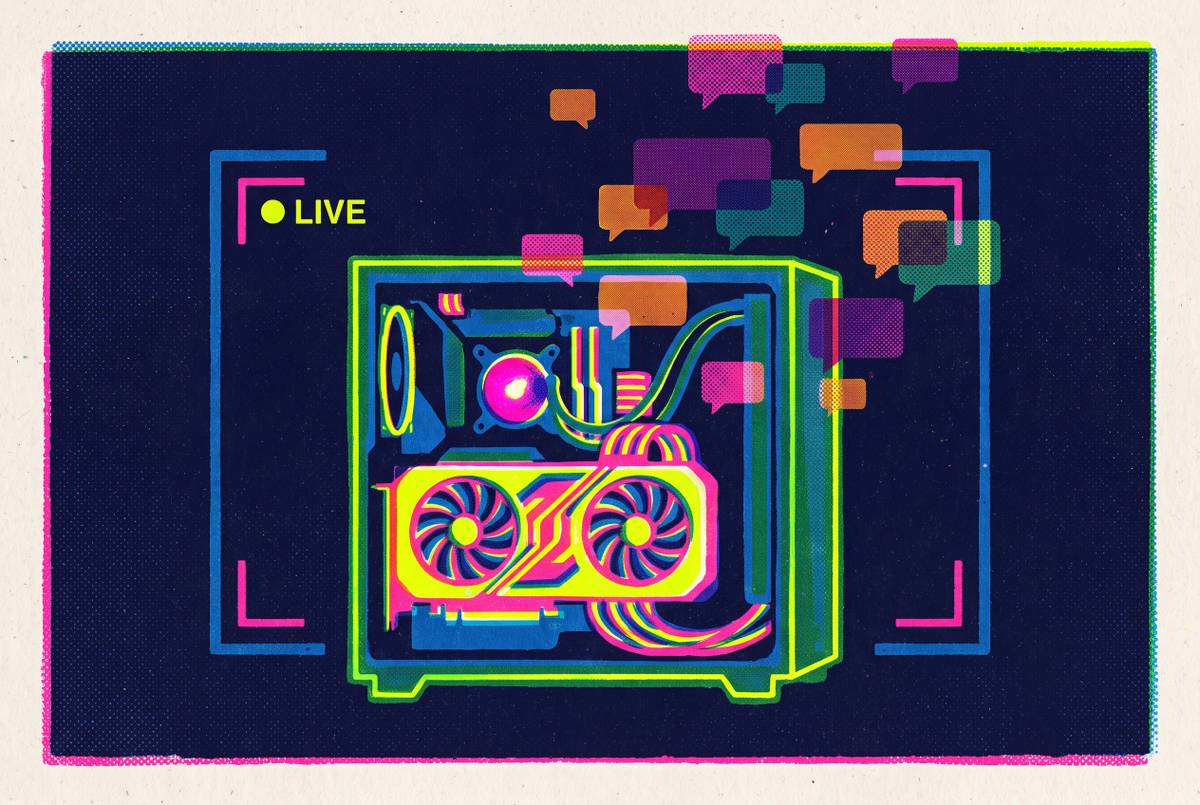
Open-frame and transparent cases push this further by making the internal hardware the actual point of display, turning careful cable routing and component placement into something closer to visual art than mechanical necessity. Specific cases have taken on real reputations inside the community for exactly this reason.
The same logic drives what happens at Maker Faire with a kinetic sculpture and produces this: the piece has to actually function, but it's also making a statement about the person who built it. A themed PC is a working computer first, but it's also a declaration, and that dual purpose is precisely what makes it a maker object rather than just a purchase. This creative work has also expanded outward from the case itself. The desk, monitor, peripherals, and ambient lighting around the machine now get treated as part of the same project, an entire environment rather than a single box sitting under a desk. Planning tools have caught up with that shift. A 3D configurator and setup builder, the kind offered on platforms like BuildCores, lets a builder work through case choice, lighting, and layout before a single part ships, which makes the creative planning stage every bit as concrete as the technical one that follows it. Source guides name specific cases that carry aesthetic identity in the community, including the Fractal Design North, favored for minimalism, the NZXT H510 Flow at roughly $60–$75, the Corsair 4000D Airflow at roughly $80, and the darkFlash DY460, cited as an "evergreen" chassis supporting 400mm+ GPUs gamingpcguru.com.
The market pressure that is testing the community's commitment right now
None of this creative momentum is happening in a stable market. The cause traces back to a sector that has nothing to do with gaming. The rapid buildout of AI data centers has pulled VRAM supply away from consumer graphics cards, and some reporting suggests Nvidia could cut gaming GPU production by as much as 40% in 2026 as global memory stays tight noobfeed.com. DDR5 and VRAM prices swinging 20% to 50% in a single quarter make it genuinely hard to plan a build budget with any confidence, a point the darkFlash budget allocation guide raises directly.
The shipment numbers confirm the pressure is real at the industry level. Global PC shipments are now expected to fall 11.3% in 2026, a sharp downgrade from the -2.4% outlook published back in November 2025, and systems priced under $500 are projected to see a 28% drop in shipments accio.com. PCWorld called 2026 the "chaos era" for PC building in a piece published that May, arguing that tariffs defined the crisis of 2025 while the memory crunch from the AI boom defines this one. The industry hasn't found stability. It's just traded one source of uncertainty for another.
Buying pre-built starts to look tempting under that kind of pressure, though it comes with its own math. Pre-built systems typically carry a 15% to 20% premium over buying the same parts individually, and in a volatile market that premium means something different depending on where the manufacturer decided to cut corners, on the motherboard, the storage, or the power supply, a point Agragati Siegel raised in the SanDisk piece. None of this should read as a eulogy for the hobby, though. The pressure is genuine, but what follows is a story of adaptation rather than retreat.
Committed builders adapting their strategy rather than stepping back
The clearest response to volatility has been a shift toward what the darkFlash 2026 budget guide calls "evergreen" components, putting a meaningful share of the budget into a high-quality case, an ATX 3.1 power supply, and solid cooling, since none of that value erodes when memory prices spike. The darkFlash DY460 gets named specifically as a chassis that holds its worth through exactly this kind of market swing. Platform choice has become a hedge too.
Alaina Yee, writing for PCWorld in a January 2026 newsletter, described redirecting her own energy rather than giving up on the hobby when new builds got too expensive to justify: Linux projects, NAS builds pieced together from old hardware, deep dives into networking, general hardware repurposing. The instinct to build finds a cheaper outlet when the market gets hostile. Danny Le made a related point about the secondhand market, describing the moment he realized how usable secondhand components actually were, comparing it to discovering used car parts were perfectly functional all along.
The buyer base has also split in a way that's easy to miss if you only look at average prices. Jon Peddie Research figures cited by voxbooster.com show enthusiasts spending $1,500 or more shrug off memory price hikes without much friction, while budget buyers are the ones pulling back, and hardware revenue overall is still expected to stay above $40 billion a year through 2028 despite the squeeze. PCWorld's "chaos era" label cuts both ways, in other words. Volatility is uncomfortable, but it also forces builders to think harder about every purchase they make, and that kind of scrutiny tends to deepen engagement with the hobby rather than push people out of it. Platform longevity serves as a hedge, with AMD AM5 repeatedly cited across multiple 2026 guides for its upgrade longevity, as builders choose platforms that let them swap CPUs as prices normalize rather than replacing entire systems.
What the current hardware landscape offers builders across budgets
At the entry level, roughly $800 buys a Ryzen 5 7600 paired with an RTX 5060, 16GB of DDR5, and a 550W power supply, which handles modern games at 1080p on high settings while sitting on the upgradeable AM5 platform bottleneckcalculator.tech gamingpcguru.com. A budget of around $1,300 shifts the sweet spot to a Ryzen 5 9600X with either an RTX 5060 Ti or an RX 9070 XT, described as the best value tier for 2026 noobfeed.com bottleneckcalculator.tech builttofrag.com gaminglikeaboss.com. A $1,500 build tends to split its budget roughly 40% toward the GPU, 25% toward the CPU, 15% toward RAM, 10% toward storage, and the rest toward the power supply and cooling noobfeed.com bottleneckcalculator.tech builttofrag.com gaminglikeaboss.com.
32GB of DDR5 is described as the gaming sweet spot in 2026, even with kit prices still elevated.
Builders keeping an eye on what's next have a fair amount to track, some of it confirmed and some still rumor. The AMD Ryzen 9 9950X3D2 Dual Edition carries 192 MB of L3 cache, and AMD's Zen 6 architecture and Intel's Nova Lake CPUs are both on the horizon, alongside NVIDIA RTX 5060 and 5060 Ti 9GB cards https://www.techpowerup.com/324233/amd-ryzen-9000x3d-series-to-keep-the-same-64-mb-3d-v-cache-capacity-offer-overclocking. An Intel Arc B770 is rumored to use a BMG-G31 chip with 32 Xe2 cores, a real jump from the B580's 20, and another AMD Radeon 9000 desktop card may arrive later in the year. NVIDIA DLSS 5 and next-generation DirectX ray tracing round out the list, though all of it should be treated at the confidence level the sources give it: some confirmed, some rumored, none guaranteed. According to builttofrag.com, a high-end build of roughly $3,000 for 4K allocates about 35% to the GPU (RTX 5090-class or RX 8900 XTX-tier), 25% to the CPU, 20% to RAM, 10% to the SSD, and 10% to everything else, and at this tier custom liquid loops become relevant but require maintenance every 6–12 months. Gamingpcguru.com puts cooling cost anchors at roughly $35 for the Thermalright Peerless Assassin 120 SE and roughly $99 for the Noctua NH-D15G2 for air cooling, while a 240/280mm AIO runs $80–$120 gaminglikeaboss.com. Raidgg.com's upgrade longevity benchmarks show a mid-range build of $750–$1,000 lasting roughly 3–4 years at 1080p before needing a GPU upgrade, a high-end build of $1,500+ lasting roughly 4–5 years at 1440p, and the GPU always being the first component that needs upgrading builttofrag.com.
PC building's continued growth even when the rational case for it gets harder to make
The numbers look contradictory until you separate the two audiences buying into them. PC gaming hardware sales hit $44.5 billion in 2025, a 35% jump from $33 billion the year before, a record by any measure, even as global PC shipments are projected to fall 11.3% in 2026 accio.com. Both of those things are true at once because the enthusiast segment and the commodity segment have stopped moving together accio.com.
Commodity buyers respond to price the way economics textbooks predict: costs rise, purchases fall. Makers don't follow that curve nearly as closely, or at least not in the same way. The identity invested in building, the skillset gained, the community built around sharing the result: none of that depreciates when a DDR5 kit gets more expensive accio.com. That's the actual mechanism behind the hobby's resilience, and it's also the reason PC building deserves recognition as the maker movement's most widely practiced form. The other disciplines under that umbrella, from robotics to metalworking, ask for specialized tools and a fairly steep entry cost in time. PC building asks for a case, a set of components, and a willingness to learn by doing, and it hands back a working computer at the end of it. That combination, useful object plus creative outlet plus community, is rare enough that it's worth taking seriously as something more than a hobby with an unstable supply chain.
Sources
- Home 2026 - Maker Faire
- The Case for Building Your Own PC in 2026 | Sandisk
- DIY PC building is a no-fly zone in 2026. (Thanks, RAM.) Now what? | PCWorld
- PC building has entered its chaos era—and I'm here for the ride | PCWorld
- Modern PC Customization Build Trends 2026
- 2026 PC Budget Allocation Guide: How to Build a PC During Memory Crisis - Build Guides - darkFlash
- Dale Dougherty
- Gaming PC Budget Guide 2026: Spend Smart, Build Better